
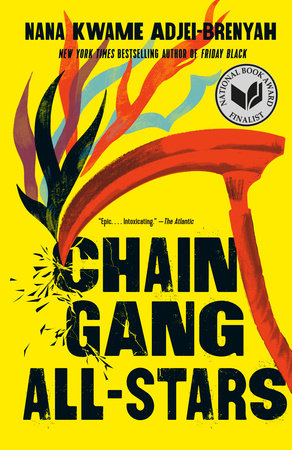
Chain-Gang All-Stars
Criminal Action Penal Entertainment turns prison sentences into a gladiator sport in a near-future United States.
About
Spoiler notice: Spoilers for the prologue fight between Loretta Thurwar and Melancholia Bishop, Thurwar’s rise in CAPE, and the identities and roles of several Links, fans, and activists. The final outcome is not described.
In a near-future United States, Criminal Action Penal Entertainment turns prison sentences into a televised combat league. People serving long terms can enter CAPE’s Chain-Gang All-Stars and fight as Links, chained to a travelling circuit of arenas where the crowd knows their nicknames, weapons and records. Winning may bring a route to freedom; losing can mean death in front of paying fans. The bargain is presented as a choice, but the world around it has made that choice inside a system built on incarceration. The matches borrow the showmanship of professional sports and reality television, complete with announcers, branded gear and audience rituals. Each fight is both a contest between prisoners and a profitable event staged for people who can watch without risking their own bodies.
The prologue begins three years before the book’s main stretch, with Loretta Thurwar entering the BattleGround as a new Link. Her opponent, Melancholia Bishop, is close to reaching High Freed status after surviving the circuit for three years. The arena is laid out like a football field, and announcer Micky Wright turns the introduction into part of the show. Thurwar is asked for a fighting name, but she gives her own. Bishop arrives with a helmet and an arsenal of weapons; Thurwar has a small corkscrew. Magnetic cuffs hold fighters to their starting platforms until the signal releases them. The crowd sees a last match and a new challenger. On the field, Bishop’s control of the fight makes room for a private exchange that Thurwar cannot yet understand. Their meeting gives the story an origin point for the name Thurwar will carry and the person she may become.
When the narrative moves forward, Thurwar has become the kind of star Bishop was: a Grand Colossal, famous enough that viewers follow her matches and close enough to freedom for the prospect to unsettle the Angola-Hammond chain. The league has put freedom only a few matches away, so Thurwar’s success can also mean leaving behind the people who have become her daily companions. She is not simply counting down to release. She wonders how to preserve the humanity of the other Links when the event’s rules and audience encourage everyone to treat them as characters in a death sport. As her last matches approach, private hopes have to exist beside very public expectations.
Hamara “Hurricane Staxxx” Stacker is both Thurwar’s partner and a star in her own right. Their bond sits inside a chain culture organised around fear: any Link may be forced to fight another, and each person’s eventual route out can divide the group. The two women try to build trust and fellowship among their teammates even while they remain part of the spectacle that makes the chain profitable. Staxxx’s performance style gives her a different relationship to the crowd. She can play with its appetite, choosing how much of herself to offer and when to deny it the easy display it wants. Thurwar’s approaching freedom makes this closeness complicated. Love does not cancel the unequal danger around them; it gives them reasons to care what happens to one another inside it. The team they build is fragile, practical, and under constant pressure from the league’s rules.
The book keeps widening its view beyond the two fighters. Hendrix Young gets chapters in his own first-person voice, while Simon J. Craft’s story is broken into fragments that follow the disorientation of solitary confinement. Tracy Lasser is tied to the Angola-Hammond chain and stages a protest on live television. Mari’s chapters connect the league to families and organizers through her experience as the daughter of an incarcerated father. These strands do not all occupy the arena.
Wil and Emily watch the BattleGrounds and LinkLyfe, the reality series that follows the fighters. Emily begins as a reluctant fan, caught between horror at the matches and fascination with their unfolding drama. That hesitation gives the audience a place inside the story: viewers can recognise the harm and still keep watching. In the arena, fans cheer for the same people whose bodies are at risk; at home, broadcasts make the violence easy to follow as a season of rivalries and favourites. Around them, CAPE’s corporate owners work to protect their control of the program, while protestors gather beyond the event’s gates and challenge the spectacle in public. The novel moves among those groups instead of leaving the league sealed inside a stadium. The sport depends on attention, money and consent, so its audience and business interests are part of the machinery that keeps it running.
The book’s footnotes repeatedly break into the action with information from outside the fictional league. Some identify real-life stories and statistics about incarceration; others cite legal documents, including material about transfers of military equipment to police departments. These notes sit beside fictional matches rather than after a long argument, so a reader can encounter a numbered detail of prison history within a page about showmanship on the field. The effect is to place CAPE in the history of American prisons, not to treat the future spectacle as a self-contained invention. It connects names and outcomes in the arena with the legal structures that exist beyond the novel’s own timeline.
Book details
- Author
- Nana Kwame Adjei-Brenyah
- First published
- 2023
- Series
- No series listed
- Subgenre
- Dystopian, Literary fiction
- Primary genre
- Literary Fiction, Sci-Fi
- Tags
- No tags for this book.
Review
Editor profile
Baby Bat
Goodreads and social links will be added soon.
- Goodreads — link coming soon
- Social media — link coming soon