
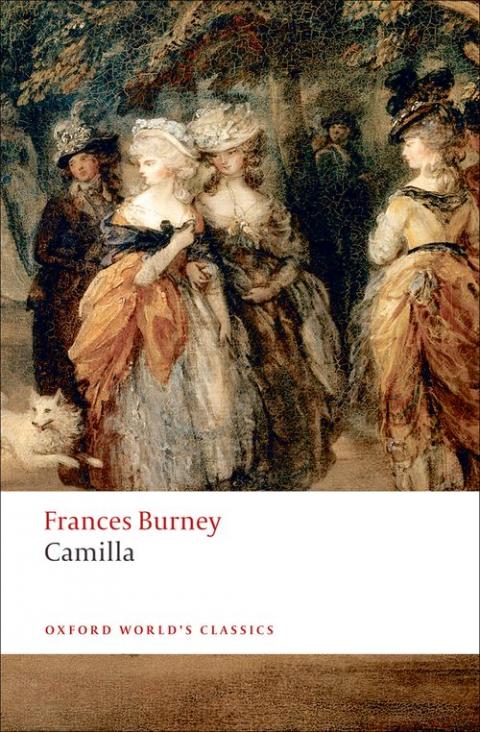
Camilla
Camilla Tyrold grows up within an affectionate family whose plans for education, inheritance and marriage seem to promise security.
About
Spoiler notice: Full-plot spoilers, including Camilla’s debts, the family’s financial troubles and the concluding marriages.
Camilla begins among the Tyrolds, a family whose affection gives its young people a sense of security that their later encounters will repeatedly disturb. Mr and Mrs Tyrold’s household at Etherington is connected with the home of Sir Hugh, the generous uncle whose attempts to arrange education, inheritance and companionship affect the whole circle. Camilla grows up alongside sisters, cousins and Edgar Mandlebert, whose place as Mr Tyrold’s ward makes him familiar before he becomes central to her hopes. Frances Burney uses this crowded family setting to examine how people acquire expectations of one another. The adults want to protect and provide, but their schemes also create obligations and assumptions that the younger generation cannot always recognise, explain or safely fulfil.
Camilla’s liveliness can be mistaken for a lack of serious feeling, although her early actions show how readily she responds to someone else’s distress. When Sir Hugh supplies money for an impoverished family, she delights in taking the assistance and joins the little boy at play. An observer concerned with propriety sees a young woman lowering herself, while Edgar sees a generosity he admires. That difference in interpretation will follow her into less innocent situations. The same willingness to become involved, to act quickly and to respond warmly can expose her to demands she has not properly considered. Burney lets the reader recognise the good impulse without treating it as a guarantee that every action arising from it will be sensible or harmless.
Edgar’s affection develops within a habit of observation that can turn against the person he loves. He values Camilla, but repeatedly judges what she seems to be doing through advice and appearances that do not give him her complete circumstances. Dr Marchmont’s experience of betrayal has encouraged a suspicious view of women, and the guidance offered to a younger man carries the limitations of those earlier disappointments. Camilla, meanwhile, can misread Edgar’s behaviour and conceal precisely the things that would explain her own. Their courtship becomes a sequence of failed interpretations between people capable of genuine attachment. Neither the strength of her feelings nor the seriousness of his intentions supplies the confidence they need to speak before a misunderstanding grows into another apparent proof.
The wider family shows the cost of other kinds of judgment. Eugenia’s illness and physical impairments make appearance an especially painful measure of her prospects, despite the intelligence and learning that distinguish her. Sir Hugh’s efforts to defend her can themselves reveal how insistently others notice what he wants them to overlook. Her history eventually includes marriage to Bellamy and suffering that leaves her doubtful about accepting another engagement. The contrast with the more admired members of the household is not simply between beauty and virtue. Eugenia understands that the value placed on attractiveness is taught by the people who reward it. Her attempt to write her own history gives that knowledge a voice beyond the comments and arrangements made on her behalf.
Camilla’s financial difficulties turn imperfect communication into an immediate threat to the family. Obligations accumulate, and she searches for expedients rather than making the disclosures that might stop the trouble earlier. Her father becomes involved and is confined over debt, bringing a public consequence to matters she has tried to keep private. When she speaks to Lady Isabella, she recognises that concealment and delay have increased the harm. Finding someone willing to lend money cannot remove every anxiety, because replacing one debt with another leaves the question of repayment. The crisis therefore makes her confront the difference between receiving help and repairing the situation that required it. Her distress includes the damage to a father whose own conduct has been governed by living within his means.
The eventual reconciliation with Edgar depends on fuller knowledge rather than a convenient disappearance of their differences. Camilla’s account to her mother names accidents, misleading appearances and mistaken reasoning as the forces that separated them. Edgar hears what her conduct had failed to communicate, and their renewed understanding makes marriage possible. It also brings practical help into the family’s unsettled affairs. Sir Hugh can return to Cleves, and the preparations join Camilla’s wedding with Lavinia’s marriage to Henry Westwyn. The celebrations are supported by acts of generosity that answer earlier assistance and relieve existing burdens. Burney gives the household a joyful reunion while keeping its happiness connected with the need to clear debts, restore a home and recognise obligations to people beyond the immediate couple.
The closing coda follows those obligations into several different futures. Edgar clears the debts in which Camilla has been involved and makes over the sisters’ intended portion to Lavinia. Sir Hugh recalls and rewards his servants, while people helped earlier in the story are not forgotten. Lionel’s misconduct has consequences that cannot be erased by an invitation home, and he takes an appointment abroad. Eugenia’s eventual acceptance of Melmond rests on an esteem and companionship that differ from the pressures of her earlier experience. Camilla and Edgar, meanwhile, retain their connections with Etherington, Cleves and Beech Park. Their settlement is also a change in how they understand each other: generous confidence replaces the combination of impulsive action and acquired suspicion that had nearly made their attachment impossible.
Book details
- Author
- Frances Burney
- First published
- 1796
- Series
- No series listed
- Subgenre
- Literary fiction, Historical fiction
- Primary genre
- Literary Fiction
- Tags
- No tags for this book.
Review
Editor profile
Baby Bat
Goodreads and social links will be added soon.
- Goodreads — link coming soon
- Social media — link coming soon