
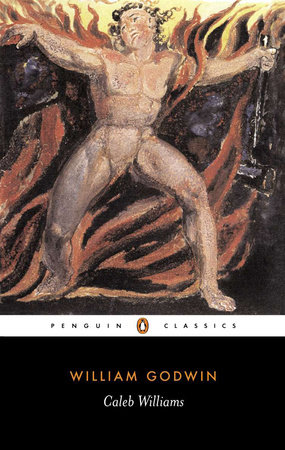
Caleb Williams
Caleb Williams becomes secretary to the admired country gentleman Ferdinando Falkland, only to discover a secret that makes his employment a trap.
About
Spoiler notice: Full-plot spoilers, including Falkland’s crime, the Hawkinses’ execution and the published ending.
Caleb Williams begins with a young man trying to put his own history on record before other people’s accounts overwhelm it. Caleb comes from a poor family in rural England, but his curiosity has given him an appetite for books, practical invention and the motives behind other people’s behaviour. After his father’s death, he enters the service of Ferdinando Falkland, a country gentleman whose abilities and apparent generosity command his admiration. Becoming Falkland’s secretary seems to offer access to a larger intellectual world. Yet Caleb writes from a position of danger, looking back on how that opportunity changed his life. His memoir makes the relationship between a powerful employer and an inquisitive dependent the centre of a story about reputation, punishment and the difficulty of being believed.
Falkland’s household contains the remains of a history Caleb does not initially understand. Through the steward Collins, he learns about Barnabas Tyrrel, another local landowner whose wealth allows him to impose his temper on the people around him. Falkland’s cultivation and public standing make him a particularly galling rival. Tyrrel’s resentment matters because those less able to resist him suffer its consequences. His dependent cousin Emily Melville admires Falkland, and Tyrrel turns her possible marriage into a means of humiliation. He chooses the coarse young Grimes as her intended husband, treating her refusal as disobedience rather than a decision she is entitled to make. The struggle between two gentlemen therefore reaches into the life of someone whose security rests on a relative’s willingness to support her.
Emily’s story shows how that dependence can become a legal trap. Tyrrel pursues her through a claim for money, and bailiffs arrive with authority to take her to the county jail even though she is seriously ill. Their insistence that they are merely carrying out orders gives his personal cruelty an institutional force. Emily dies, while another strand of the history follows Tyrrel’s persecution of the tenant Hawkins and his son. After Tyrrel is murdered, suspicion eventually settles on the Hawkinses, and both are executed. These events establish the human cost behind Falkland’s troubled reputation. They also make it dangerous to assume that a charge, a legal proceeding or an accepted public account must accurately identify the person responsible for the harm.
Caleb’s curiosity gradually turns those old events into an immediate confrontation. During a fire at the house, he tries to open a trunk that has become an object of his suspicions. Falkland subsequently admits that he killed Tyrrel after a public humiliation and concealed his guilt while the innocent Hawkinses suffered. His confession does not say that he planted the evidence against them; it does establish that he allowed their deaths to protect himself. Falkland describes his attachment to an honourable name even while acknowledging the crimes committed to preserve it. He binds Caleb to secrecy and threatens him. Knowledge brings no corresponding power: the secretary now understands his employer’s torment, but he also becomes a person whose freedom the employer cannot safely tolerate.
Once Caleb attempts to leave, the narrative becomes a succession of confinements, escapes and precarious attempts to live somewhere beyond the reach of his history. A theft accusation supplies a public explanation for pursuing him, and imprisonment turns the imbalance between employer and servant into an immediate physical reality. Escaping custody does not remove the charge or give Caleb a dependable way to clear his name. Gines, a violent pursuer with grievances of his own, becomes an especially persistent threat. The pursuit is not one seamless operation controlled by Falkland at every stage; independent hostility and the rewards attached to capture help it spread. Caleb’s need for work, shelter and ordinary companionship repeatedly brings him into contact with people who can be influenced by what they have heard about him.
The resulting pressure changes the meaning of freedom. Caleb can move between places, alter his appearance and temporarily evade recognition, but each refuge remains vulnerable to a story about his supposed guilt. His memoir gives these repeated losses a continuity that the strangers encountering him cannot see. It also preserves his conflicted feelings about Falkland, whose intelligence and earlier virtues remain difficult for him to dismiss. Seeking justice eventually means bringing an accusation before a magistrate, but Caleb does not arrive at the hearing with uncomplicated satisfaction. Falkland is carried in looking gravely ill, and the sight confronts Caleb with the suffering of the person he has spent so long fearing. Public vindication now requires him to expose someone he still regards with painful admiration.
At the hearing Caleb explicitly accuses Falkland of Tyrrel’s murder, then turns his speech towards remorse, praising Falkland and reproaching his own conduct. He does not simply withdraw the factual allegation. Falkland admits his guilt, and dies three days later. The truth has finally reached an audience with authority to hear it, but Caleb finds himself more miserable rather than released into the happy future an acquittal might seem to promise. His self-accusation is moral anguish, not a revelation that he secretly committed the original crime. He continues writing so that Falkland will not survive in a partial account either. The published ending leaves both men’s histories intertwined: Caleb’s attempt to restore his name becomes a record of how deeply the pursuit has altered his capacity to imagine a life beyond it.
Book details
- Author
- William Godwin
- First published
- 1794
- Series
- No series listed
- Subgenre
- Literary fiction, Modern classics
- Primary genre
- Literary Fiction
- Tags
- No tags for this book.
Review
Editor profile
Baby Bat
Goodreads and social links will be added soon.
- Goodreads — link coming soon
- Social media — link coming soon