
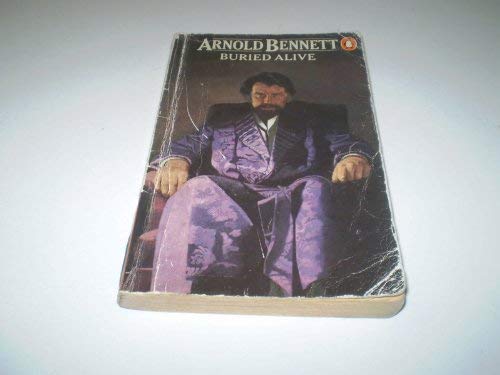
Buried Alive
Celebrated painter Priam Farll finds public attention unbearable and relies on his valet Henry Leek to manage everyday life.
About
Spoiler notice: This overview includes the mistaken burial, Priam's identity trial and the final voyage.
Priam Farll can paint pictures that make his name important to people who have never met him, but ordinary encounters leave him almost helpless. Arnold Bennett introduces the artist inside an extravagant dressing gown in a neglected South Kensington house, surrounded by an uncomfortable mixture of luxury and disorder. At fifty, he wants protection from the demands of the world without quite admitting how much he needs somebody to provide it. His valet Henry Leek supplies much of the practical support that makes withdrawal possible. Buried Alive turns that dependence into a comic problem with unexpectedly large consequences. The celebrated name belongs to a man poorly suited to performing celebrity, and the machinery of public recognition will prove much more efficient at honouring an idea of him than understanding his actual wishes.
Leek's sudden illness brings a doctor into the household and removes the arrangement upon which Priam relies. After the valet dies, Dr. Cashmore assumes that the dead man was Farll and the survivor his servant. Priam recognizes a chance to escape the publicity and formalities he dreads. Instead of correcting the misunderstanding, he answers questions in a way that confirms it, even acknowledging that he is the valet. The deception grows through small replies made under pressure rather than through an elaborate plan. That makes it easier to enter and harder to stop. Other people now have business to conduct around the famous painter's death, while the living artist must confront the consequences of having surrendered the name through which they would normally know him.
Alice Challice enters through correspondence found among Leek's belongings. A matrimonial arrangement intended for the valet brings Priam to a meeting where she believes him to be the man who wrote to her. Her confident, practical conversation offers a relief from the kinds of social performance that trouble him, though the mistaken identity remains between them. Bennett develops the encounter through the awkwardness of an ordinary outing rather than treating Alice as merely another complication in a trick. She has opinions, expectations and a capacity to take charge. Priam's desire for human contact persists beneath his fear of it, and the new acquaintance gives that desire somewhere to go. Their eventual life together in Putney provides a domestic possibility very different from the lonely household in which the story began.
Meanwhile, the public story of Farll's death acquires its own authority. Burial in Westminster Abbey makes the error part of national commemoration, giving a private evasion the weight of an institution's solemn judgment. The discrepancy is absurd precisely because the honours are so serious. The person best able to explain what happened is also the person least willing to expose himself to the attention that an explanation would produce. Assuming Leek's identity has not given him the capacity to manage every difficulty attached to it, either. He has exchanged one set of expectations for another while retaining the same temperament. As practical concerns draw him back toward painting, the gift that distinguishes him creates a route by which the identity he abandoned can return.
The dealer Oxford's visit to the attic where Priam works brings commercial expertise into that private refuge. Alice thinks in terms of the useful income her husband's pictures can provide, even while their artistic qualities remain largely mysterious to her. Oxford looks at the work with a trained eye and addresses the painter as a master. Recognition here comes through what Priam can do, but it does not remain a quiet understanding between two people. The pictures enter a dispute that turns his identity into a matter for lawyers, witnesses and public speculation. The narrator repeatedly contrasts the certainty claimed for institutions with their dependence on accidents, assumptions and human behaviour. A talent that cannot comfortably express itself in conversation must now survive a spectacle organized around verbal proof.
The trial's fascination eventually centres upon two marks on Priam's neck. He refuses to remove his collar, and the public treats that refusal as evidence against him, while experts attempt to establish identity through the paintings themselves. Alice's testimony supplies another kind of intelligence: plain-spoken, resistant to intimidation and unwilling to accept that legal solemnity makes a foolish question sensible. The prospect of evidence from Lady Sophia Entwistle, with whom Priam has a painful personal history, finally changes his resolve. He removes the collar, and the dispute is brought to its formal conclusion. Bennett makes the result depend upon a private pressure that the judicial machinery could not produce on its own. The public can congratulate its institutions afterward without acknowledging how contingent their success has been.
Before leaving England, Priam and Alice visit Westminster Abbey to find the inscription marking his supposed resting place. Its restrained simplicity moves him in a way the surrounding publicity has not, reviving the wish to paint better pictures and the gladness of still being alive. Leek's remains are subsequently removed from the place where they have rested under the wrong name. The couple then sail for Algiers, taking the story beyond the country that has so awkwardly celebrated and investigated its artist. Priam's limitations have not vanished; the ending accepts them beside the ability that makes his work valuable. His thought about what will happen at his next funeral preserves the joke, while the prospect of painting in Alice's company gives the renewed life a purpose he can understand.
Book details
- Author
- Arnold Bennett
- First published
- 1908
- Series
- No series listed
- Subgenre
- Literary fiction, Modern classics
- Primary genre
- Literary Fiction
- Tags
- No tags for this book.
Review
Editor profile
Baby Bat
Goodreads and social links will be added soon.
- Goodreads — link coming soon
- Social media — link coming soon