
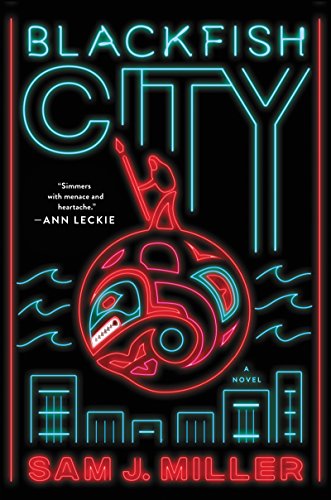
Blackfish City
In a climate-damaged future, the floating Arctic city of Qaanaaq offers refuge while concentrating power among landlords, crime groups and wealthy shareholders.
About
Spoiler notice: This account covers the climate-damaged setting, Qaanaaq’s social divisions, the arrival of the orcamancer, the four central viewpoints, and the speculative conditions affecting them. It avoids later revelations about the characters’ connections and the novel’s ending.
Blackfish City imagines a near future in which climate change and political upheaval have displaced populations across the world. Qaanaaq, a floating city in the Arctic Circle, offers shelter to refugees and their descendants, but its survival has not produced an equal society. Software runs much of the city’s administration, while landlords, crime groups and wealthy shareholders hold the power that shapes ordinary life. The city’s tightly engineered systems coexist with crowded housing, poverty and environmental damage. Qaanaaq is therefore more than a dramatic setting: its design makes the distribution of safety and opportunity visible. People depend on the city for refuge while living under arrangements that leave many of them exposed to exploitation and instability.
The pressure on that system becomes harder to ignore when a mysterious woman arrives riding an orca, with a polar bear beside her. People call her the orcamancer, and her appearance generates rumors before anyone understands her purpose. Her arrival intersects with four lives already shaped by the city’s uneven rules. Ankit is a political aide trying to help her institutionalized mother. Her brother Kaev is a fighter whose neurological injury affects his life outside the arena. Soq is a nonbinary courier working the city’s dangerous routes, while Fill belongs to the wealthy class through his family and faces a very different vulnerability. The novel follows these characters from distinct social positions as their separate concerns begin to touch.
Miller structures much of the narrative through the changing perspectives of Ankit, Kaev, Soq and Fill. The shifts let the reader encounter Qaanaaq through people who know different parts of it: administrative corridors, fighting venues, precarious street work and wealthy households. An underground broadcast called City Without a Map adds another channel of information about the place and its inhabitants. Since no one viewpoint contains the whole picture, the book’s account of power develops through partial knowledge, rumor and repeated events seen from different angles. This form also keeps the city’s conflicts personal. A policy or institution may look abstract from a distance, but each character meets it as a constraint on family, work, health or movement.
Two speculative ideas sharpen that connection between private life and public order. The breaks is a disease associated with intimacy that can place fragments of other people’s memories in the minds of those it affects. It brings bodily risk together with questions of memory, stigma and connection. Nanobonding, by contrast, links a human and an animal through technology, joining their perceptions and senses. People and animals with these bonds are treated as threats by parts of society, so the relationship becomes a point where prejudice and control act on both partners. These elements are not detached marvels added to the setting. They affect how characters understand themselves and one another, and they expose how quickly institutions turn unfamiliar forms of life into reasons for exclusion.
Qaanaaq’s political economy gives the novel’s speculative conflicts a recognizable material shape. Refugee populations face hostility even though many residents’ families arrived in the city only a generation or two earlier. Housing can stand empty while people lack secure homes, and criminal networks operate alongside the wealthy interests that benefit from the status quo. Software-managed administration does not make these decisions neutral; the city still reflects the priorities of those with property and influence. Against this background, each central character is negotiating a different kind of leverage. Ankit works close to government, Kaev is entangled with the people who control his fights, Soq survives through mobility and messages, and Fill’s inheritance connects him to power even as illness complicates his life.
City Without a Map gives this environment a voice that does not belong to the official machinery. The anonymous underground podcast circulates accounts of Qaanaaq from outside its formal channels, creating a counterpoint to a city managed by software and controlled by hidden shareholders. Its presence complicates the boundary between reporting, rumor and resistance: information can help people recognize shared conditions, but listeners still have to decide what to trust and what to do with what they hear. This narrative thread also broadens the novel beyond four individual lives. The city’s inhabitants are not only subjects of policies or background figures in the protagonists’ stories; they form an audience and a public whose understanding of Qaanaaq can shift as competing accounts travel through it.
The arrival of the orcamancer draws these strands toward a larger question: what forms of kinship and collective action can persist in a place organized around unequal access? Family in the book extends beyond conventional household ties, joining people whose histories and loyalties may be hidden from them at first. Human relationships with animals also carry emotional and political weight, especially where a bond is feared or criminalized. Miller places this intimate material beside migration, class conflict, gender identity and the fight to shape a shared home. The result is a story about a city under strain and the people trying to alter its direction. Its early mysteries create momentum, while its wider concern remains the possibility of connection among residents whom Qaanaaq’s systems keep apart.
Book details
- Author
- Sam J. Miller
- First published
- 2018
- Series
- No series listed
- Subgenre
- Dystopian, Post-apocalyptic
- Primary genre
- Sci-Fi
- Tags
- No tags for this book.
Review
Editor profile
Baby Bat
Goodreads and social links will be added soon.
- Goodreads — link coming soon
- Social media — link coming soon