
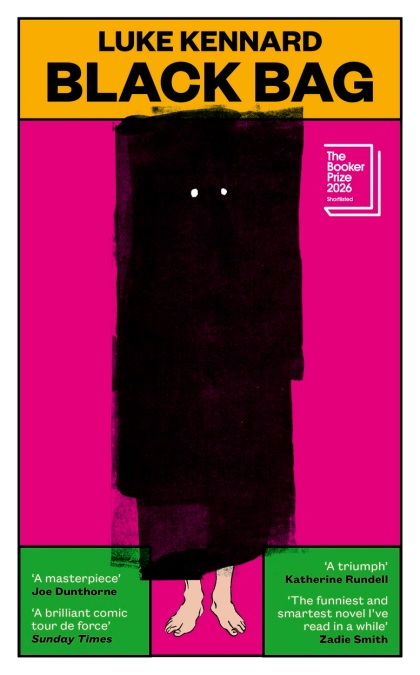
Black Bag
An unemployed actor accepts a paid role in Dr Blend’s university psychology experiment: he sits silently in lectures zipped inside a large black leather bag.
About
Spoiler notice: Spoilers for the premise and opening set-up; later developments and the ending are withheld.
In Black Bag, Luke Kennard turns an unusually literal performance into a question about how a person becomes visible. The narrator is an unemployed actor in his thirties whose name the reader never learns; the label Black Bag comes from the role he accepts in a university experiment. Dr Blend pays him to sit silently at the back of lectures zipped inside a large black leather suit bag with eyeholes. The premise is comic, but the anonymity is not a simple disguise. It removes the ordinary signs by which other people identify and judge him while making his strange outline impossible to ignore. Kennard uses that contradiction to open a story about work, recognition and the uncertain self an actor carries between performances.
Before the experiment, the narrator’s circumstances are precarious in recognisable ways. In the Booker-published extract, he describes being behind on rent and bills, counting the cost of ordinary purchases and relying on a meal bought by his childhood friend Claudio. The detail grounds the book’s absurdity in economic pressure: acting has not provided stable work, and the narrator measures his life against practical costs even while he wants to devote himself to art. Claudio has found a very different position, becoming wealthy through online streaming and advertising. Their friendship contains affection, teasing and an old familiarity that makes each man’s self-presentation harder to sustain. The set-up therefore places the bag inside a larger question: what kind of person can afford to treat creativity as a calling, and what happens when a friend offers help that might alter the friendship’s balance?
The experiment gives the narrator a job, but it also turns him into an object of observation. Dr Blend wants to see how students respond to a silent, conspicuous figure across a series of autumn-term lectures. The Booker guide identifies the premise as drawing on a real 1960s experiment, while Kennard says he became more interested in the person playing the part than in the study’s results. That shift helps explain why the novel’s attention falls on the performer’s experience as much as on the observers’ reactions. Black Bag is hidden inside an outfit yet watched; he is present in a room while withholding the usual ways of participating in it. The arrangement makes social perception part of the plot and invites readers to consider how quickly strangeness becomes a category attached to a person.
The disguise also gives the story a way to examine identity without treating it as a settled inner truth waiting to be uncovered. The narrator is already an actor, accustomed to roles, auditions and the gap between how a part is described and what performing it feels like. Inside the bag, that gap becomes physical: the character is identified by the object he wears, while his private thoughts remain his own. The title’s capitalisation, noted in the Booker guide, makes Black Bag both a name and an imposed description. Because his actual name is never disclosed, the label can feel comic, dehumanising and oddly freeing at once. Kennard builds a character whose public identity is reduced to a costume even as the narration insists on the restless, self-conscious mind within it.
Claudio’s response extends the experiment beyond the lecture theatre. As a successful streamer, he sees the potential to turn the unusual situation into an online opportunity. That possibility connects the novel’s campus setting to a wider economy in which attention can be measured and monetised. Black Bag’s paid role begins as research, but once other people imagine an audience for it, the boundary between experiment, performance and content grows less secure. The Booker judges describe the novel as engaging with anonymity, online rackets and the pressure of contemporary work; these concerns converge in the question of who controls the meaning of the bag. The narrator may be the person inside it, yet the professor, students and friend each approach the image from a different interest. Visibility becomes a resource other people can organise around.
The book’s humour works alongside questions that are less comfortable. Its premise invites spectacle, but the narrator’s financial anxiety and artistic uncertainty keep the comedy attached to vulnerability. Kennard has said the story grew from thinking about the struggling artist in a moment when arts and culture are undervalued and doubt can seem larger than possibility. That comment offers context for the novel’s interest in masculinity: the protagonist is not presented as a representative answer to a social debate, but as a particular man trying to find a workable relation to ambition, money, friendship and love. The Booker guide also notes that a professor of post-humanism develops questions of her own, including whether someone concealed inside a bag can be loved. The absurd question brings intimacy into the experiment without resolving it in advance.
The novel’s form reinforces this attention to the unstable border between public speech and private thought. The Booker guide notes that Kennard does not use quotation marks, a choice that can blur dialogue and the narrator’s interior voice. In the authorized opening extract, conversation with Claudio moves through the page beside the narrator’s anxious observations and self-corrections, so the reader encounters social exchange through a mind that is continually interpreting itself. This style suits an actor who is always aware of how he appears, even before the bag gives that awareness a visible shape. The result is a campus novel where lectures and research provide a frame for questions that spill into ordinary life: whether a role can become an identity, whether attention can substitute for connection, and how a person might make meaningful work when the available choices feel narrow.
Book details
- Author
- Luke Kennard
- First published
- 2026
- Series
- No series listed
- Subgenre
- Literary fiction, Campus novel, Experimental fiction
- Primary genre
- Literary Fiction
- Tags
- No tags for this book.
Review
Editor profile
Baby Bat
Goodreads and social links will be added soon.
- Goodreads — link coming soon
- Social media — link coming soon