
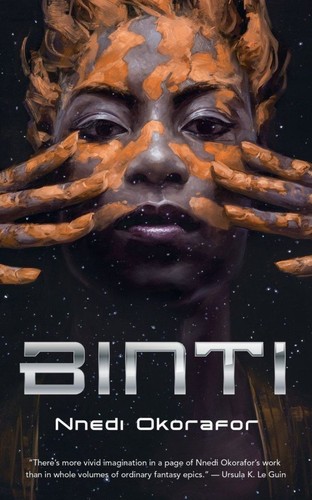
Binti
Binti is the first of the Himba people to be offered a place at Oomza University, which is a planet away and requires her to leave her family without permission.
About
Spoiler notice: Full-book spoilers, including the ending. Covers the first volume only; no sequel events.
Binti leaves home before her family knows she has decided to go. At sixteen, she has earned admission and financial support from Oomza University, an opportunity no other member of her Himba community has taken. The departure begins with luggage, an unreliable transporter and the anxiety of reaching the launch port alone. Behind her is the Root, the family house that connects generations of relatives and their work. Ahead is a place among strangers who may not understand why leaving is such a serious act. The opening keeps the achievement and its cost together: admission recognises her mathematical ability, but accepting it means breaking expectations about where she belongs and what her future should be.
Her knowledge has grown within that family rather than outside it. Her father makes astrolabes, sophisticated devices used for communication, stored information and personal identity. Binti has learned the craft and become a master harmonizer, working with mathematical patterns and currents. Mathematics is also a discipline of attention. On the journey, she can calm her mind by imagining and dividing complex equations, a practice called treeing. These abilities join technical skill with forms of understanding that feel spiritual as well as scientific. Oomza offers further study, but the foundation already exists at home. Binti’s departure consequently does not divide the story into an ignorant homeland and an enlightened university. She brings useful knowledge with her, even when people around her fail to recognise its worth.
The first barriers are human. Khoush travellers stare at her clothes, touch her hair without permission and disparage the otjize covering her skin. Their contempt reaches beyond unfamiliarity into an assumption that Himba customs make her lesser. Her braided hair carries patterns connected to family history, while otjize is a mixture made from materials associated with the land she has left. What others treat as dirt is part of how she understands beauty and belonging. Her presence at the launch port places those meanings under scrutiny before the voyage has even begun. The story’s interstellar scale does not remove social prejudice. Binti must navigate it alongside the ordinary practical demands of travelling for the first time.
Aboard Third Fish, a living ship carrying students to Oomza, the experience briefly changes. Other young scholars give Binti company, and the possibility of sharing an intellectual life begins to seem real. Then the Meduse attack. The jellyfish-like beings kill the passengers, including people she has begun to know; Binti and the pilot survive. A journey towards education becomes a confined struggle to stay alive among attackers who intend further violence. The Meduse’s conflict with the Khoush predates her presence aboard the ship. She has neither caused it nor arrived equipped with diplomatic authority. Nevertheless, she becomes the person positioned to communicate across it. The novella keeps that disproportion visible: a student must face consequences created by institutions and communities much more powerful than she is.
The edan she carries proves crucial. It is an ancient object whose functions were not understood when she found it, but it protects her from the Meduse and makes their speech intelligible. After hiding in her room, Binti discovers that communication is possible where everyone has assumed enmity. Okwu, a young Meduse who has tried to kill her, notices the otjize on her skin. The mixture can heal Meduse injuries. An object treated as an obscure relic and a practice mocked by other travellers now affect whether conversation can continue. Neither makes Binti all-knowing or safe. They give her limited opportunities to negotiate, and she uses those opportunities while still needing food, water and protection.
The Meduse chief’s grievance reveals why Oomza is a target. Khoush researchers have taken its stinger and placed it on display at the university without consent. The institution Binti hopes to join is implicated in the violation that has brought violence to her journey. Learning this does not make the murdered passengers responsible or turn the attackers into harmless victims. It gives her something specific to negotiate over rather than an abstract plea that enemies should stop fighting. Her contact with Okwu develops through that effort, making the Meduse intelligible as beings with loyalties and injuries, while leaving the danger of their actions present. Binti’s task is to carry a demand between groups that have ceased to expect a meaningful answer from one another.
Representing the Meduse requires a further risk: Binti puts aside the edan and is stung, placing her body as well as her safety within the encounter. At Oomza, she helps secure the return of the chief’s stinger and an agreement that allows Okwu to become a student. Only afterwards does she fully recognise the bodily consequence of the encounter: her hair has become tentacle-like, connecting her to the Meduse. The university is now an arrival point for two outsiders, rather than the uncomplicated reward she imagined. Binti makes otjize from local materials and eventually calls her family. That closing contact leaves room for continuity without pretending nothing has changed. Her education begins with skills from home, survival through negotiation and a new identity she must learn to inhabit.
Book details
- Author
- Nnedi Okorafor
- Published
- 2015 (earliest confirmed edition)
- Series
- Binti, book 1
- Subgenre
- Space opera, First contact
- Primary genre
- Sci-Fi
- Tags
- No tags for this book.
- Reading order
- Also on this shelf: Binti: The Night Masquerade (book 3)
Review
Editor profile
Baby Bat
Goodreads and social links will be added soon.
- Goodreads — link coming soon
- Social media — link coming soon