
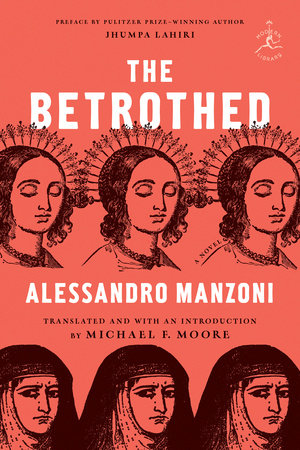
The Betrothed
Renzo and Lucia hope to marry in seventeenth-century Lombardy, but Don Rodrigo uses armed intimidation to stop their wedding.
About
Spoiler notice: Full-plot spoilers, including Lucia's abduction and vow, the plague, Don Rodrigo's death and the couple's eventual marriage and family life.
Renzo Tramaglino and Lucia Mondella want to get married. That modest ambition brings them into conflict with a world in which a powerful man's wishes can outweigh ordinary people's rights. Alessandro Manzoni begins The Betrothed beside Lake Como, among the mountains, roads and villages around Lecco, in November 1628. Lombardy is under Spanish rule, and the landscape's beauty offers little protection from the men who exercise authority within it. Don Abbondio, the priest expected to perform the wedding, encounters two armed retainers on his way home. Their instruction is unequivocal: the marriage must not happen. They name Don Rodrigo as their patron, leaving the frightened priest to work out how to obey. Before the lovers can speak their vows, someone else has already decided what their future is allowed to be.
The encounter establishes how Manzoni's society functions. Proclamations threaten severe punishments for armed intimidation, yet the repeated need to issue them exposes their weakness. People with influential patrons can make use of protections that are unavailable to their victims. Don Abbondio understands that imbalance and chooses his own safety, passing the consequences to the couple who need him. Renzo and Lucia attempt another way of securing the marriage, entering the priest's room with witnesses and trying to declare themselves husband and wife before him. The scene turns into chaos when he throws a tablecloth over Lucia and raises the alarm. Its physical comedy has a painful underside: people seeking an ordinary lawful life have been driven into a desperate intrusion, while the man obstructing them can make himself look like the victim.
The failed attempt takes place amid a more direct danger, as Don Rodrigo's men search Lucia's home. The couple flee with her mother, Agnese, and seek help from the friar Fra Cristoforo. Leaving the village separates them from familiar surroundings without ending the reach of those pursuing them. Lucia's story passes through Monza and the orbit of Gertrude, whose religious life has been shaped by family pressure and the fear of exposure. The convent therefore cannot be treated as a simple refuge outside worldly coercion. Lucia is eventually abducted and taken to the stronghold of the formidable figure known as the Unnamed. Her helplessness confronts him with the human reality of the violence he commands. His distress leads him to Cardinal Federigo Borromeo, whose welcome makes repentance seem possible, and their encounter turns toward arranging Lucia's release.
Renzo's journey exposes a different kind of danger in Milan, where hunger, anger and confused explanations of scarcity fill the streets. He arrives amid a bread riot and hears accusations against bakers and officials, including rumours of deliberate poisoning. The crowd offers the excitement of a shared cause, but its actions also destroy the places and equipment needed to produce food. Renzo notices that contradiction even as curiosity carries him along. His involvement brings him under official suspicion, and escape becomes part of his struggle to find a place where he can live and work. Manzoni moves between the individual caught in the uproar and the institutions supposedly managing it. The city is full of voices claiming to understand the crisis, while the people most exposed to its consequences have little reliable protection.
The historical disasters grow beyond the quarrel that first drove the lovers from home. Famine, the destructive passage of armies and plague unsettle whole communities, making private plans dependent on events no household can control. When Renzo reaches the lazaretto, the place where plague sufferers are gathered, finding Lucia means searching through mass suffering rather than simply reaching a convenient reunion. Fra Cristoforo is there, worn down by his work among the sick. Renzo's anger at Don Rodrigo still seeks an object, and the friar challenges the desire for revenge, speaking from his own history of killing a man before entering religious life. Forgiveness is consequently a difficult demand made within a scene of bodily ruin. It does not depend on pretending that the persecution was harmless or that Renzo has no reason to be angry.
Even when Renzo finds Lucia, another obstacle remains. During her captivity she has promised the Virgin that she will never marry if she is delivered safely to her mother. The vow gives the hoped-for reunion a cruel complication: Renzo has found the person he loves, but she believes gratitude for her rescue requires surrendering their life together. Fra Cristoforo considers the promise alongside her earlier commitment to Renzo and offers to release her from it through his religious authority. Lucia herself asks for that release. Don Rodrigo's death eventually removes the threat that still frightens Don Abbondio, and the priest becomes willing to publish the banns. The couple finally marry, although the happiness of the occasion includes grief for Fra Cristoforo, who has died. Their future becomes possible through help, survival and loss rather than through a single victory over their persecutor.
Manzoni continues past the wedding to ask what living happily might actually involve. After leaving their village, Renzo becomes upset by neighbours who think Lucia less beautiful than the stories about her had led them to expect. A later business opportunity with his cousin Bortolo brings a more comfortable settlement near Bergamo, and the family grows, beginning with their daughter Maria. The children learn to read and write, while Renzo turns his adventures into lessons about avoiding trouble. Lucia gently questions the completeness of his conclusions: she did not go looking for misfortune, yet it found her. Their final understanding allows for suffering caused by one's own mistakes and suffering that innocence cannot prevent. Faith can help them endure both. The novel leaves them with a shared life and a way of understanding it, without promising that prudence or goodness can make anyone invulnerable.
Book details
- Author
- Alessandro Manzoni
- First published
- 1827
- Series
- No series listed
- Subgenre
- Literary fiction, Literary historical fiction, Modern classics
- Primary genre
- Literary Fiction, Historical Fiction
- Tags
- No tags for this book.
Review
Editor profile
Baby Bat
Goodreads and social links will be added soon.
- Goodreads — link coming soon
- Social media — link coming soon