
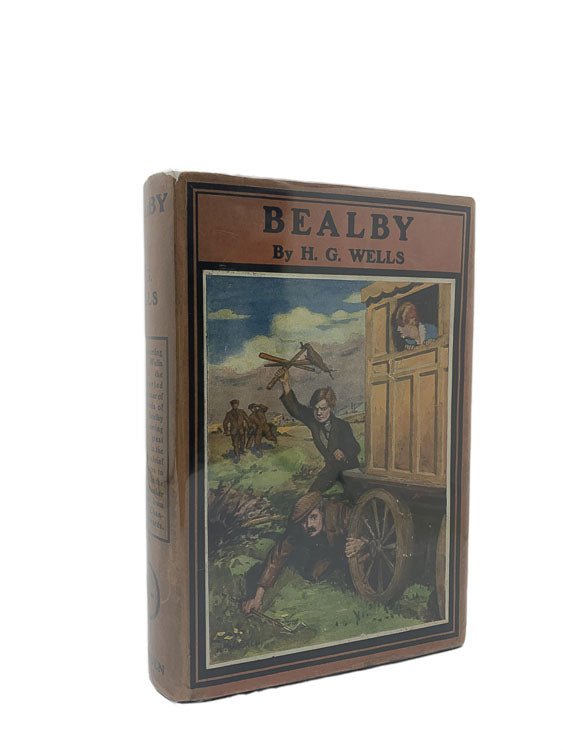
Bealby
Arthur Bealby refuses to accept the servant’s life arranged for him at Shonts.
About
Spoiler notice: This overview discusses the caravan accident, Bealby’s testimony and his return home at the ending.
Bealby begins with a boy being told that his future has already been arranged. Arthur Bealby is the stepson of Shonts's gardener, Mr. Darling, and the adults around him regard a place in the great household's service as an opportunity he should gratefully accept. He wants to be something else, without having a practical scheme for becoming it. H. G. Wells makes that collision between established usefulness and youthful freedom the starting point for a week of runaway adventures. The estate's grandeur provides a comic contrast with the boy's experience of entering it: magnificent rooms exist above him, while his allotted world consists of passages, duties and the authority of servants who are themselves subject to other people.
His introduction to work offers little encouragement. The steward, Mr. Mergleson, orders him about, and Thomas's bullying turns resentment into a desire to retaliate. When Bealby finally attacks with a toasting fork, the actual injury frightens him out of the violent fantasies he has entertained. He flees, setting further confusion in motion around the household's distinguished visitors. The comedy depends on consequences which travel well beyond the original quarrel. Lord Moggeridge, the Lord Chancellor, interprets disturbances through his existing assumptions about dignity and disrespect, while Captain Douglas becomes entangled in suspicions of practical joking. Bealby is central to the disorder without possessing anything like the knowledge or influence that the adults' explanations of it might suggest.
Outside Shonts, the desire for freedom quickly acquires the practical difficulty of finding food and somewhere to stay. A caravan party offers a different world, less rigidly arranged than the household he has escaped. Judy Bowles, Madeleine Philips and their companions bring him into the life of a holiday expedition, and he makes himself useful while becoming captivated by Madeleine. His adopted name, Dick, helps him inhabit an identity at a distance from the troublesome boy of the estate. The experience allows romance and admiration into the story, but Wells keeps its unevenness visible. Bealby's feelings are powerful to him, while the adults remain occupied by relationships and concerns whose full meaning he cannot follow.
The second disastrous departure grows out of an attempt to leave things well. Bealby works at removing a branch from the supports beneath the caravan, convinced that he can do so safely. He cannot. The vehicle starts moving downhill, William is caught inside, and the resulting upheaval draws others into an increasingly physical dispute. The distance between a pleasing intention and an appalling result becomes an immediate lesson rather than a moral delivered after the fact. Bealby can see no prospect of explaining himself successfully to the people converging on the wreck. Running away promises another beginning, but it also means abandoning the protection, food and companionship he has temporarily found. Each escape leaves him freer in one sense and more exposed in another.
His encounter with Billy Bridget makes that exposure harder to ignore. The tramp offers food and company, then begins to turn companionship into a claim upon the boy's money and obedience. Bealby discovers that someone outside respectable employment can still want a subordinate. Bridget's talk about property and theft does not remove the boy's misgivings, and the money entrusted to his supposed protector becomes increasingly difficult to regard as his own. Wells lets the contrast emerge through small transactions, personal discomfort and the practical mechanics of travelling together. Escape from the servant hierarchy has not carried Bealby into a society without coercion. It has placed him where he has fewer dependable means of resisting it, despite the expansive promises with which the partnership begins.
At Crayminster, pursuit and mistaken assumptions produce another widening confusion. A reward and accusations turn the boy into a fugitive among people who are eager to explain what they think they have seen. His flight feeds a disorder which draws in local grievances and other people's quarrels. Meeting Captain Douglas appears to offer a route back into safety. The Captain needs a witness to clear his own name with Moggeridge, and takes Bealby to London believing the facts can be established through a few straightforward questions. The final interview exposes the weakness in that expectation. Bealby's answers are sincere but incomplete, and the Lord Chancellor supplies the interpretation before the boy can explain. Social authority and certainty do not make him an attentive listener.
Douglas leaves the encounter to reconsider his own course and eventually departs for France. Bealby, left behind, has to ask Lord Chickney for help getting home. The journey back brings relief, confusion and a more serious understanding of the dangers into which he has wandered. Shonts itself looks altered by the events he only partly understands. At the gardener's cottage he finds his mother pale and withdrawn, and offers to try again as a steward's-room boy. Her astonished silence is the last response the narrative gives him. Wells does not show a settled future or an adult explanation which makes the whole adventure clear. The holiday closes with a chastened child seeking security, while the reader has seen enough of the surrounding world to question how wisely its supposedly competent people govern it.
Book details
- Author
- H. G. Wells
- First published
- 1915
- Series
- No series listed
- Subgenre
- Literary fiction, Modern classics
- Primary genre
- Literary Fiction
- Tags
- No tags for this book.
Review
Editor profile
Baby Bat
Goodreads and social links will be added soon.
- Goodreads — link coming soon
- Social media — link coming soon