
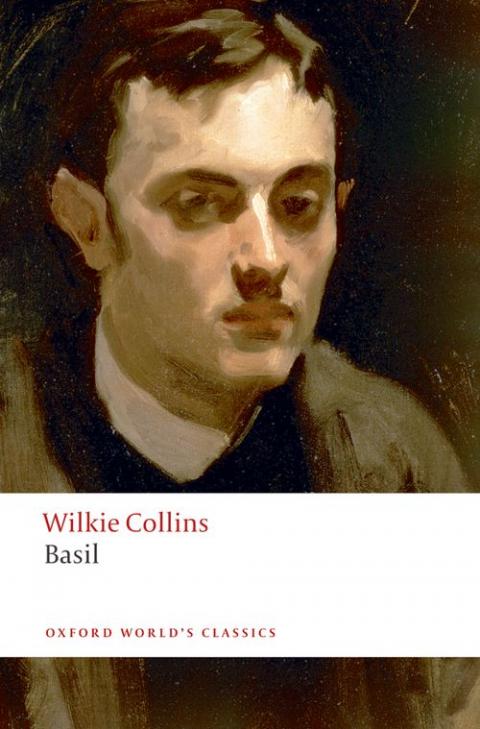
Basil
Basil, a wealthy younger son, secretly marries Margaret Sherwin despite the social boundary separating their families.
About
Spoiler notice: Full-plot spoilers, including the secret marriage, Basil’s attack on Mannion and the deaths and family reconciliation at the end.
Basil begins with its narrator writing in isolation, looking back on a decision whose consequences have driven him far from his former home. Published in 1852, Wilkie Collins’s novel follows a wealthy younger son who believes that he has found the woman with whom he will share his future. His family’s position gives him money and considerable freedom, but his father’s pride in their rank makes certain choices almost impossible to discuss. Basil’s attachment to Margaret Sherwin develops within that gap between what he can privately arrange and what he dares publicly acknowledge. His account comes from someone who already knows the disaster ahead. The reader follows the earlier confidence through the recollections of the man who has survived its collapse.
The relationship starts on a London omnibus. Basil notices Margaret, becomes absorbed in her appearance and follows her until he discovers where she lives. That pursuit brings him to North Villa and into contact with her father, Stephen Sherwin. Basil is prepared to cross a social boundary that he knows his own father would resist, but his willingness to marry does not give him a clear understanding of the household he has entered. He approaches Margaret through the hopes he has already formed about her. Sherwin, meanwhile, recognises the advantages of an association with a man whose family possesses wealth and standing. Their negotiations develop around money, secrecy and arrangements for the future, long before Basil understands how much he has failed to ask.
Sherwin directs the arrangements for a secret wedding and requires a year to pass before the married couple live together. Basil agrees, anticipating that patience will eventually deliver the life he wants. During his visits, he gives Margaret lessons and tries to sustain their attachment within the restrictions imposed on them. Her mother’s ill health and uneasy behaviour trouble him, yet he does not fully understand the warnings implicit in her anxiety. Robert Mannion also occupies an important place in the household. Basil regards his assistance as dependable and accepts his involvement in matters affecting Margaret. Trust grows out of proximity and apparent helpfulness, leaving Basil vulnerable to someone whose private purposes he has scarcely considered. The waiting year therefore increases his expectations without bringing equivalent knowledge.
On the final evening before the separation is supposed to end, Basil learns that Margaret has gone to a party with Mannion. He follows events beyond the explanation offered at North Villa and reaches a hotel, where he listens through a thin partition to their voices. What he hears destroys his belief in the marriage. The discovery is followed by his own terrible act: waiting outside, he seizes Mannion by the throat and throws him face down onto a newly repaired road. The granite stones injure Mannion’s face. Basil’s retrospective account records both his violent intention and the confusion that follows it. Margaret escapes his grasp, while he wanders through the streets in a state of mounting distress, unable to recover command of his thoughts.
The aftermath unfolds through explanations and documents as well as direct encounters. Sherwin tries to maintain Margaret’s innocence, while Mannion’s later account discloses motives and a history that Basil did not know when he trusted him. These competing accounts force him to reconsider the relationship in which he invested his future. His own family connection also comes under intolerable strain: the secrecy that once seemed to protect his plans now leaves him facing his father’s exclusion. Margaret’s final illness brings another irreversible loss. Basil reaches a point of forgiveness, but that change cannot prevent her death. Mannion survives the earlier assault, carrying its visible consequences with him, and his hostility continues beyond the destruction of the marriage. Basil cannot simply leave the household and regard the affair as finished.
His retreat to Cornwall offers little protection once Mannion follows him. Fear and suspicion spread among the people of the fishing hamlet where he has been staying, and Basil finds himself driven into further isolation. During a walk through thick coastal mist, he reaches a dangerous promontory above a chasm into which the sea surges. Mannion confronts him there, insisting that the pursuit will continue wherever he goes. Basil briefly feels the temptation to throw him over the cliff, but turns away. The fatal fall that follows occurs when Mannion loses his balance while making a threatening gesture. He slips down the wet rock and disappears into the chasm. Witnessing that death brings Basil no immediate peace; his journal deteriorates into accounts of weakness, disturbing visions and an inability to write coherently.
The concluding letters carry the story beyond those broken entries. Medical intervention and communication with his family bring his brother Ralph and sister Clara into the crisis, and Basil eventually recovers. A final letter written nearly nine years later records a reconciliation with his father before the older man’s death. Ralph has become head of the family, while Basil lives quietly with Clara at Lanreath Cottage in Breconshire. Their retirement includes practical concern for poorer neighbours, giving his days a purpose outside the ambitions and concealed arrangements of his earlier life. He authorises the publication of his account anonymously. The recovered narrator can tell what happened without turning survival into a restoration of the marriage or the future he once imagined.
Book details
- Author
- Wilkie Collins
- First published
- 1852
- Series
- No series listed
- Subgenre
- Literary fiction, Modern classics
- Primary genre
- Literary Fiction
- Tags
- No tags for this book.
Review
Editor profile
Baby Bat
Goodreads and social links will be added soon.
- Goodreads — link coming soon
- Social media — link coming soon