
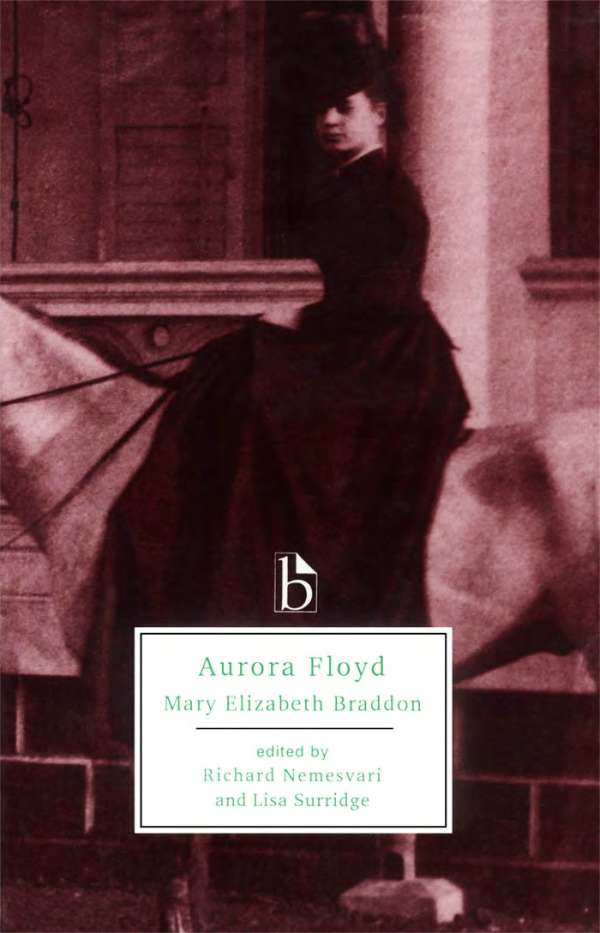
Aurora Floyd
A wealthy banker’s daughter brings a concealed first marriage into the life she shares with John Mellish.
About
Spoiler notice: Full-plot spoilers, including Aurora’s first marriage, Conyers’s murder and the identification of his killer.
Aurora Floyd grows up inside a fortune that can protect her material comfort without protecting her from inexperience. Her father, Archibald Martin Floyd, is a banker whose own late marriage to Eliza, an actress, has already disturbed the expectations of relatives and neighbours. After Eliza’s death, his daughter becomes the centre of his affection. Felden Woods gives Aurora an impressive home, but wealth and a trusted family circle do not teach her how to recognise every kind of deception outside it. Mary Elizabeth Braddon begins with the histories behind the household’s respectable surface, making the young heiress’s future depend on a private past that money cannot conveniently remove. The family’s happiness is vulnerable to what remains unspoken within it.
Aurora’s presence draws Talbot Bulstrode and John Mellish into a courtship complicated by that hidden history. Talbot’s expectations cannot readily accommodate what he does not understand about her, while John’s attachment offers a more generous acceptance. The eventual marriages place the men in different relationships with the same family: John becomes Aurora’s husband, and Talbot marries her cousin Lucy. Those arrangements do not put Talbot outside Aurora’s story. He will become someone to whom she can turn when her life at Mellish Park is threatened. Braddon keeps the women’s kinship and the men’s differing responses in play, allowing an earlier romantic disappointment to become part of the network through which the later crisis can be faced.
The central secret is a first marriage to James Conyers, her father’s groom. In explaining it to Talbot, Aurora rejects the idea that a grand passion accounts for her conduct. She describes a schoolgirl’s attraction to a handsome face and confident manner, encouraged by Conyers’s claims about his background and by a governess who helped make him seem romantic. Their shared interest in horses supplied opportunities for familiarity that she did not recognise as manipulation. Her father’s discovery and the attempt to separate them did not prevent the marriage. Looking back, Aurora has to distinguish the man she imagined from the person she encountered, while recognising that her own choices have exposed people she loves to consequences they could not anticipate.
Conyers’s return as a trainer at Mellish Park brings that earlier life into the household John believes he shares with his wife. A false report of the groom’s death and Aurora’s concealments have made the truth difficult to explain without causing further hurt. Her money gives her resources, but also something another person can try to obtain through pressure. The danger is therefore more intimate than the arrival of an unwelcome employee. Someone who knows what she has hidden can make an ordinary conversation or arrangement carry a meaning her husband does not see. Aurora’s efforts to manage the situation preserve the secret for a time while increasing the distance between her visible conduct and the reasons behind it.
When Conyers is murdered, that distance becomes a source of suspicion. His death follows an assignation involving Aurora, and the circumstances around her movements and the concealed relationship make it easy to construct an accusation from incomplete knowledge. She has a past she fears revealing, but that does not mean she committed the killing. Braddon makes the reader follow how those two propositions can be confused by the people trying to understand events at Mellish Park. Aurora’s eventual disclosure to Talbot is an appeal for help as well as a confession of earlier conduct. Her concern is directed towards John’s suffering, so finding a way forward requires more than protecting her own name from the story already circulating around her.
The investigation turns towards material evidence that can challenge those assumptions. Money, a pocket-book and a waistcoat connect the crime with Stephen Hargraves, the servant whose behaviour has become part of the household’s danger. Talbot helps bring the hidden evidence to light, and the closing account establishes the motive and method through Hargraves’s confession. He followed Conyers, watched the meeting, then shot him while he was looking over the money. The killing was committed for gain, not by the woman whose secret had made her appear a convenient suspect. His trial ends in conviction and execution. The resolution separates Aurora’s responsibility for her earlier choices from responsibility for a later act of violence carried out by someone else.
The final L’Envoi moves the surviving family away from the place where those histories converged. Aurora and John travel to the south of France with Archibald Floyd, and Talbot and Lucy join them with their baby. A child is also born to Aurora, giving the closing scene a domestic focus beyond the accusation and investigation. John rewards the detective despite Talbot having captured Hargraves, while Samuel Prodder remains welcome as a visitor to the family. The novel does not need to pretend that Aurora has emerged exactly as she began: its final portrait makes her less defiantly bright and more tender. Her future is placed within renewed companionship and care, with the exposed secret no longer controlling every attempt to live beside the people she loves.
Book details
- Author
- Mary Elizabeth Braddon
- First published
- 1863
- Series
- No series listed
- Subgenre
- Victorian fiction, Literary fiction, Historical mystery
- Primary genre
- Historical Fiction, Literary Fiction
- Tags
- No tags for this book.
Review
Editor profile
Baby Bat
Goodreads and social links will be added soon.
- Goodreads — link coming soon
- Social media — link coming soon