
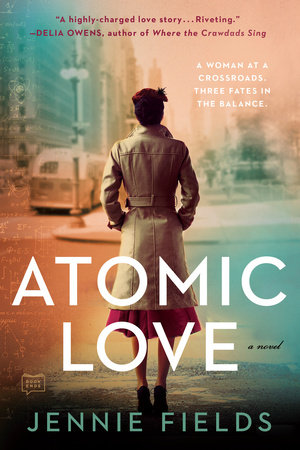
Atomic Love
Chicago, 1950: physicist Rosalind Porter still grieves her lost laboratory career and affair with former Manhattan Project colleague Thomas Weaver.
About
Spoiler notice: Spoilers for the central premise: Rosalind Porter is drawn back into nuclear research when the FBI asks her to spy on former colleague Thomas Weaver. The summary avoids the investigation’s findings and the novel’s final choice.
Atomic Love opens in Chicago in 1950, five years after Rosalind Porter’s work as a physicist on the Manhattan Project and her relationship with fellow scientist Thomas Weaver have both ended. The two losses remain bound together. Rosalind carries guilt about the bomb her work helped create, while the end of her affair has left her heartbroken and separated from the laboratory that once gave her professional purpose. She has nearly accepted a more conventional life when Weaver contacts her again. The FBI approaches at the same time: Special Agent Charlie Szydlo asks her to spy on Weaver, whom the Bureau suspects of passing nuclear secrets to the enemy. Rosalind understands the knowledge at stake because she helped develop it. The novel’s opening therefore puts scientific responsibility, private grief and national security into the same decision.
Rosalind’s position is difficult precisely because no part of it is only professional. She is asked to assess the former colleague she still loves, but the request also returns her to work from which she has been absent. Her knowledge makes her useful to the FBI and gives her a reason to take the danger seriously; her history with Weaver makes distance hard to maintain. At the same time, the book’s synopsis describes her as a woman who has almost resigned herself to a conventional life and desperately misses the laboratory. That tension gives her choice more than one measure: loyalty to a person, responsibility toward the consequences of scientific discovery, and the question of what kind of life she can build after being pushed out of her vocation. The novel lets those pressures overlap rather than presenting them as a clean contest between romance and duty.
Charlie Szydlo complicates the assignment. The FBI agent is a former prisoner of war haunted by his own past, and something about him draws Rosalind in. She is therefore placed between two men whose histories intersect with hers in different ways. Weaver is associated with the earlier laboratory and the love affair that ended alongside it; Charlie arrives through an official request that may expose Weaver, yet he also becomes emotionally significant. The surrounding question is not only which man Rosalind loves, but whether she can trust her own attachments while dealing with secrets that could carry consequences well beyond her private life. Fields frames the suspense through conflicted loyalties rather than through an investigator who stands outside the events she is trying to understand.
The setting makes the personal dilemma inseparable from its moment in history. Chicago in 1950 is the novel’s fictional stage, where the recent Manhattan Project and the fear of nuclear secrets shape what Rosalind knows and what others want from her. Her scientific past is not a detachable backstory: it gives her a particular understanding of the destructive power at issue, while also reminding her of work and identity she has lost. The story uses espionage to make private decisions feel consequential, but it keeps Rosalind’s feelings in view as the danger grows. Her grief about the bomb and her heartbreak over Weaver are already intertwined before the FBI intervenes. New contact with both men turns that unresolved past into an active problem, and the investigation forces her to decide what she owes to people, knowledge and country when those claims point in different directions.
Fields has explained that she wanted to write about a female scientist in the 1940s and 1950s. Her mother, a University of Chicago-trained biochemist, had been expected to give up her career after marriage and missed science throughout her life. Fields also learned that her mother’s cousin had worked on the Manhattan Project, and her research led her to Leona Woods, a scientist on the project’s primary team. Fields says she did not intend to tell Woods’s particular story; instead, she created Rosalind as her own character and explored what might happen to a woman in that position afterward. That distinction matters: Rosalind Porter and the novel’s espionage plot are fictional, even though the author drew on family experience and historical research to imagine the constraints around a woman scientist. The book’s concern with lost work and the effort to reclaim it grows from that stated creative starting point.
The title joins the novel’s two principal currents. “Atomic” points toward scientific knowledge with consequences larger than any one person, while “love” names the attachments that make Rosalind’s decisions intimate and difficult. The story moves between those scales: the suspicion surrounding Weaver and the secrets he may possess, Charlie’s attempt to recruit Rosalind, and the emotions that return as she becomes close to each man. As her feelings deepen, so does the danger. That structure allows the book to ask how affection can coexist with suspicion and how a person’s past work can remain present after the work itself has stopped. Atomic Love is historical fiction shaped as an espionage story and a love triangle, centred on a scientist whose expertise, regrets and desires all matter to the choice before her.
Book details
- Author
- Jennie Fields
- First published
- 2020
- Series
- No series listed
- Subgenre
- Historical fiction, Espionage, Historical romance
- Primary genre
- Historical Fiction, Literary Fiction
- Tags
- No tags for this book.
Review
Editor profile
Baby Bat
Goodreads and social links will be added soon.
- Goodreads — link coming soon
- Social media — link coming soon