
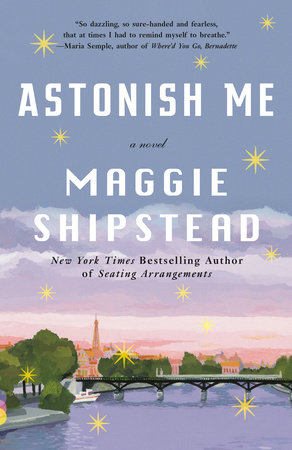
Astonish Me
Former ballerina Joan once helped Soviet dance star Arslan Rusakov defect, then left the stage and made a family with Jacob.
About
Spoiler notice: Spoilers below for Arslan’s return to Joan’s family through Harry’s ballet career and the pressure this places on her marriage; the novel’s ending is not disclosed.
Astonish Me begins with Joan already carrying a history she would rather keep out of sight. As a young American ballerina in Paris, she falls into an affair with Arslan Rusakov, a celebrated Soviet dancer, and helps him defect to the United States. His career rises; hers narrows, and heartbreak makes the disparity difficult to ignore. Years later, Joan has built a quieter life in California with Jacob, her longtime admirer, and their son Harry. She teaches dance and tries to be content with the choices that moved her away from the stage. Then Harry’s unusual talent brings the past close again. Shipstead makes this return more than a collision between a suburban household and ballet’s glamour: it forces Joan to consider what she left behind and what her family has been allowed to believe.
The novel moves back and forth across decades, filling in Joan’s earlier life as its later consequences come into view. A decision that first seems like a private response to love or ambition can acquire a different weight when the story revisits it from another point in time. This structure lets readers assemble the history alongside Joan’s family, while leaving space between what happened and what each person understands. Paris, New York and Southern California offer sharply different surroundings for the same question: how does a person live after a defining moment has passed? The shifts also place two generations within one developing pattern. Harry’s rise in ballet does not simply repeat Joan’s career; it gives the family another chance to encounter the desires and compromises attached to the art.
Joan’s relationship with ballet is shaped by the distance between wanting a life onstage and having the talent to sustain one. She has seen Arslan’s gift carry him into international fame, while her own career ends sooner and more modestly. That imbalance can turn admiration into longing and love into a measure of what she lacks. The novel does not make artistic ambition a simple virtue or a mistake. Ballet offers Joan a world of discipline and intensity, but it also teaches her to compare, to accept limits, and to keep moving after a performance or opportunity is over. Her later work as a teacher keeps her close to dance while giving her a different place within it. Watching Harry excel complicates that position: pride in a child’s ability arrives beside memories of her own ambitions.
Shipstead’s professional dance world asks what perfection costs the people who pursue it. Dancers work through demanding routines in bodies that can be injured, and careers depend on physical gifts that cannot be secured by effort alone. The discipline of rehearsing can resemble control, yet the performer’s body remains vulnerable to fatigue, chance and time. That tension touches the people around the dancers as well. Trust is necessary when partners share movement and depend on one another’s timing and safety; attraction, jealousy and competition can grow in that close collaboration. Away from the stage, the attempt to direct every outcome has its own limits. Joan’s experience suggests that a carefully arranged life can still be altered by the ambitions and secrets she thought she had put behind her.
Family and attraction repeat themselves in ways that are suggestive but never exact. Jacob has loved Joan since childhood; Harry grows up devoted to Chloe. The younger pair inherit a family history, though they do not simply step into their parents’ roles. Their choices place questions of nature, nurture and example beside one another: what is passed down through temperament, what is learned by watching, and what can a child know about the adults whose decisions preceded them? Harry’s ballet talent links him to Joan and Arslan, but the connection does not settle what kind of person he will become. The older generation’s stories can prepare the younger one for some dangers while obscuring others. These echoes make the novel’s family portrait attentive to change as well as inheritance.
Jacob’s idea that every family has a mythology gives the domestic plot a quiet source of pressure. A family story can make scattered events feel coherent, but it can also protect a version of the past that someone needs. Joan’s history touches the balance Jacob and Joan have made together, and keeping parts of it unspoken becomes a choice with consequences. The question is not merely whether a secret will surface; it is what happens to affection when people discover that they have been living with different accounts of the same family. Shipstead is interested in how memory and belief work inside ordinary intimacy. A person may sincerely hold a story that cannot explain everything, and truth can matter even when no one can recover the past in a perfectly settled form.
Ballet supplies the novel with a language for these pressures. A performance makes effort appear controlled and complete, while the work that produces it depends on repetition, risk and other people. Shipstead also draws on ballet’s history: the discussion of Emma Livry, whose tutu caught fire, places beauty beside the hazards of the form, while the ballet called Rodina carries the meaning of “motherland.” Such images connect the stage to questions of home, inheritance and the price of being seen. Astonish Me follows Joan from a life organized around dancing to one that must accommodate her son’s gifts and the return of old attachments. Its time shifts let one generation’s hopes cast shadows into the next, while keeping the final meaning of those connections open until the story has brought its separate histories together.
Book details
- Author
- Maggie Shipstead
- First published
- 2014
- Series
- No series listed
- Subgenre
- Literary fiction, Family novel
- Primary genre
- Literary Fiction
- Tags
- No tags for this book.
Review
Editor profile
Baby Bat
Goodreads and social links will be added soon.
- Goodreads — link coming soon
- Social media — link coming soon