
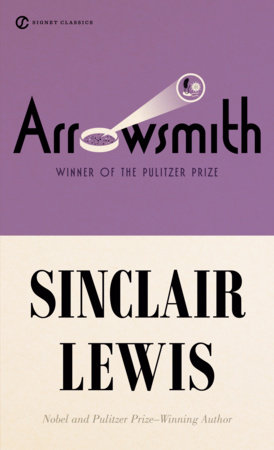
Arrowsmith
Martin Arrowsmith wants to understand disease through experiments, but his medical career repeatedly asks him to become something else: a reassuring doctor, a public-health promoter or an institutional success.
About
Spoiler notice: This overview includes Leora’s death, the outcome of the plague research and Martin’s final decision.
Martin Arrowsmith first encounters medicine in an office that is also a living room, a storehouse of specimens and a place for its elderly occupant to sleep off his drinking. Doc Vickerson is hardly an immaculate professional example, but his books and collections give a curious boy something more exciting than the clothing business downstairs. Martin reads anatomy, helps the doctor and enjoys knowing things that impress other children. Sinclair Lewis’s 1925 novel follows that mixture of curiosity and ambition into adult life. Martin wants to discover how things work, yet he also wants to be recognized as the person who discovers them. The difference becomes harder to ignore as his career takes him through medical training, private practice, public health and research institutions whose promises do not always match the work they permit.
At the University of Winnemac, bacteriologist Max Gottlieb teaches him that an observation matters more than a comfortable theory. When Martin repeatedly obtains an unexpected result, Gottlieb welcomes the challenge instead of asking him to force the experiment into agreement with established doctrine. Learning this discipline does not cure Martin of vanity. Sent to Zenith General Hospital for a bacterial strain, he tries to impress a probationer nurse by pretending to be a doctor. Leora Tozer punctures the performance, and their admission that both have been showing off begins a much easier companionship. Martin is already entangled with Madeline Fox, but Leora becomes his wife and the person to whom he can confess his disappointments. Their closeness gives the career story a domestic centre that his professional ambitions repeatedly strain.
The work available to a qualified doctor is not necessarily the work Martin wants. Rural practice in Wheatsylvania brings the prospect of treating patients and earning a living, along with the frustrations of establishing himself. In Nautilus he joins the public-health department under Almus Pickerbaugh, whose enthusiasm arrives in slogans, verse, newspaper clippings and impressive-sounding statistics. Martin can see a purpose in carrying scientific knowledge to the public, but he struggles with the confusion of promotion and investigation. His duties include complaints, correspondence, supplies, inspections and publicity; the laboratory time he imagined is only one demand among many. Leora hears his fear that he will once again become a disappointed, unpopular failure. Lewis gives these workplaces their own daily clutter, so that Martin’s impatience is tested against actual responsibilities rather than an abstract dislike of bureaucracy.
Research at the McGurk Institute places Martin closer to the experiments he values, but wealth and prestige bring their own expectations. When plague threatens the West Indian island of St. Hubert, his bacteriophage preparation offers a possible intervention. Gottlieb wants him to compare people receiving it with people who do not, so that its value can be established rather than merely proclaimed. Others see an immediate duty to distribute anything that might help. Gustaf Sondelius, the energetic campaigner accompanying Martin, presses for widespread treatment and an aggressive attack on the epidemic. The Institute’s trustees also anticipate the credit a successful mission would bring. Martin departs carrying laboratory equipment and a commitment to experimental controls, while different people expect a rescuer, a public triumph or an answer to a scientific question.
St. Hubert makes those expectations painfully concrete. In St. Swithin’s parish Martin divides the population for comparison, while elsewhere disease, fear and urgent demands surround the visiting researchers. Leora, who insisted on accompanying him, is left at Penrith Lodge while he works away from her. She falls ill in isolation, and Martin returns to find her dead. His grief destroys his determination to maintain the plan as he had promised. He gives phage to those who ask for it, leaving Stokes to continue the parish experiment and its records. People from the untreated group also seek injections, weakening the comparison. The epidemic eventually subsides and Martin is celebrated, but the praise cannot supply the missing certainty. He knows that he has not obtained the complete proof that others are eager to announce on his behalf.
Back in New York, bereavement and recognition leave him restless in different ways. Joyce Lanyon, the wealthy widow he met during the epidemic, offers affection and a social life far removed from Leora’s company. She has helped with practical work on St. Hubert, and her interest in Martin is more substantial than an attraction to a fashionable scientist. Yet their eventual marriage brings competing ideas about how he should live. Joyce sees value in friends, recreation and the opportunities his standing could provide; Martin alternately enjoys these things and resents their demands. Terry Wickett presents another possibility at Birdies’ Rest in Vermont: support a small laboratory through commercial work while protecting long stretches for independent experiments. Martin is pulled between the appeal of Joyce’s comfortable world and the freedom of Terry’s rougher one.
The choice becomes unavoidable when Rippleton Holabird offers him advancement toward the McGurk directorship. Joyce welcomes the honour and argues that he could encourage other researchers. Martin sees administration consuming his own chance to work, refuses the position and leaves for Vermont. The decision costs his family something; Joyce challenges his willingness to leave their son, and the novel does not make that objection disappear. Nor does the independent laboratory produce an instant discovery that would settle every argument in his favour. Martin and Terry earn their keep, pursue difficult experiments and discuss a modest community of researchers who could remain free to disagree. In the closing scene they sit in a boat and contemplate years of work that may fail. Martin has chosen a way of living with scientific uncertainty, while the personal consequences remain unresolved.
Book details
- Author
- Sinclair Lewis
- First published
- 1925
- Series
- No series listed
- Subgenre
- Literary fiction, Modern classics
- Primary genre
- Literary Fiction
- Tags
- No tags for this book.
Review
Editor profile
Baby Bat
Goodreads and social links will be added soon.
- Goodreads — link coming soon
- Social media — link coming soon