
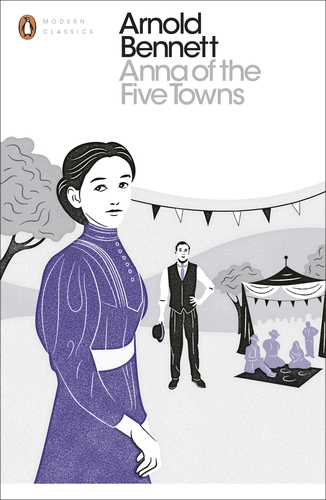
Anna of the Five Towns
On the eve of her twenty-first birthday, Anna Tellwright lives under the tight control of her wealthy, miserly father in the industrial Five Towns.
About
Spoiler notice: This overview includes Anna's destruction of the forged bill, her marriage and Willie Price's fate.
The children pouring out of Sunday school at the beginning of Anna of the Five Towns belong to a community whose religious, commercial and domestic lives continually overlap. Henry Mynors can appear as a respected chapel figure before becoming important to Anna Tellwright in other ways. The streets around them contain the potteries, shops and houses through which Arnold Bennett gives his industrial setting a physical form. Moving along a road means passing through visible differences in wealth and standing, from manufactories and cottages to the homes of prosperous citizens. Anna lives within that geography while remaining unusually restricted in her experience of it. Managing a household has given her competence, but it has supplied few of the freedoms or social opportunities that such competence might seem to deserve.
Her father Ephraim controls the atmosphere of the house through habits that make affection difficult to separate from fear. Anna can resent his domination while still loving him, and Bennett refuses to simplify that bond into a feeling she can discard by deciding it is unreasonable. Her twenty-first birthday brings an astonishing disclosure: the fortune inherited through her mother's family, invested and accumulated under his trusteeship, now amounts to nearly fifty thousand pounds. Legal ownership does not immediately alter the relation between them. She receives the news in the clothes of someone interrupted while preparing a meal, then must follow his instructions through securities and calculations she scarcely understands. The contrast between the scale of her property and the narrowness of her ordinary life gives the inheritance its unsettling force.
The chapel community offers a wider circle without placing her beyond the demand to judge herself. During the revival, Anna struggles to attain the inward assurance she believes a sincere religious life should bring. Her thoughts move between guilt, longing and admiration for Mynors, whose apparent goodness and confidence make her own uncertainty more painful. A journey to a prayer meeting becomes a furtive act requiring arrangements for the breakfast she normally prepares. Even spiritual ambition must negotiate domestic permission and the fear of being noticed. Bennett places these efforts beside workers moving through dusty streets toward another day of labour. The town continues its routines while Anna wonders whether its people understand the immense importance of the struggle occupying her mind.
Friendship with the Suttons and the prospect of a relationship with Mynors draw her into a more comfortable social world. At their house she encounters carpets, pictures, servants and easy hospitality that reveal how differently a household can operate. The invitation itself causes anxiety about when to arrive and how to behave; acceptance is something she has to learn by entering rooms where other people seem already at home. A holiday at Port Erin leads to her engagement to Mynors, and the return journey briefly gives her a happiness she will remember. His considerate arrangements make travel pleasant and manageable. Yet arriving home restores her father's criticism and her younger sister Agnes's loneliness, showing how quickly delight can become a question of money spent, duties interrupted and someone else left behind.
Willie Price's difficulties create a different kind of attachment. His family's financial collapse and his father's death place him in a vulnerable position that Anna cannot regard with detached charity. His admission that he has forged a bill makes helping him dangerous as well as emotionally urgent. She dislikes the superiority she believes she detects in Mynors's kindness and feels a closeness to Willie that resists that division between benefactor and recipient. Her promise to help confronts her with the practical limits of obedience: her father possesses the document that could expose him, and she cannot persuade herself that Ephraim will willingly relinquish it. The question becomes whether she can act upon her sympathy when doing so requires a direct breach of his authority.
Her answer comes before dawn. Going downstairs barefoot, she enters the room whose privacy her father's power has protected without the need for a locked bureau. She finds the bill, tears it apart and burns it in the kitchen grate. The physical action is quick, but the realization of what she has done follows her back upstairs. Protecting Willie means accepting a conflict with Ephraim that she expects him never to forgive. Bennett gives the moment no comfortable separation between bravery and terror, or compassion and concealment. Anna can make an independent decision, but she cannot simply become someone upon whom the consequences of family disapproval have no claim. The act changes what she has been willing to do while leaving the habits of feeling formed in that house deeply intact.
The final chapter makes the difference between action and freedom still more painful. Anna meets Willie as he appears ready to leave for Australia and gives him an envelope containing a hundred-pound note, asking him not to open it until Melbourne. Their encounter reveals to her that they love one another, yet she proceeds with her promised marriage to Mynors. She resolves to be a good wife and imagines Willie prospering abroad with the help she has provided. The narrator allows the reader knowledge she never receives: Willie does not establish that new life, and an abandoned pitshaft keeps the secret of his death. The money remains unclaimed. Her imagined success for him becomes a source of endurance, closing the novel upon the gulf between a devoted intention, the life she accepts and an outcome beyond her knowledge.
Book details
- Author
- Arnold Bennett
- First published
- 1902
- Series
- No series listed
- Subgenre
- Literary fiction, Modern classics
- Primary genre
- Literary Fiction
- Tags
- No tags for this book.
Review
Editor profile
Baby Bat
Goodreads and social links will be added soon.
- Goodreads — link coming soon
- Social media — link coming soon