
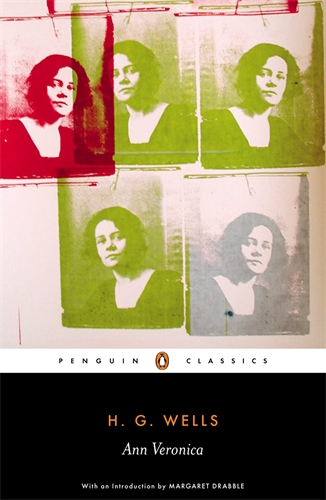
Ann Veronica
At twenty-one, science student Ann Veronica Stanley wants to continue her education and make choices for herself, but her father expects obedience and disapproves of her plans.
About
Spoiler notice: This overview includes Ann Veronica's relationship with Capes and the novel's ending.
Ann Veronica Stanley wants something more demanding than permission to amuse herself. At twenty-one, she is intelligent, capable and eager to discover what she can do, but her family still treats her independence as a question to be settled by somebody else. Her father has refused the university education she wanted and compromised on a science course that allows her to remain at home. Books, theatre visits and even possession of a latch-key become matters for negotiation. The immediate dispute concerns an art students' dance, yet H. G. Wells makes it the point at which accumulated frustrations become impossible to ignore. Ann Veronica has been taught to avoid thinking about parts of life that adults nevertheless expect marriage to settle. She wants knowledge, experience and a meaningful occupation before accepting the future already being prepared for her.
Leaving Morningside Park for London gives that desire a practical test. Ann Veronica can list her possessions, estimate the value of jewellery and imagine supporting herself through work. What she cannot yet describe with the same confidence is how she will actually find employment. Her plan alternates between brave certainty and the fear that the world is waiting to humiliate her. Friends help get her luggage away, making departure exciting and possible, but their encouragement cannot supply an income. Wells follows the uncomfortable difference between being capable by the standards of school and knowing how to make that capability pay. Ann Veronica has rejected dependence on her father without discovering an immediate alternative. The city enlarges her opportunities while exposing how much her upbringing has left her to learn.
A loan from Ramage appears to provide the necessary breathing space. Forty pounds lets her continue her scientific education, and the biological laboratory offers a concentration of purpose she finds deeply satisfying. Its specimens, lectures and shared work all contribute to understanding the forms of life. The clarity of that activity contrasts with the confused discussions and competing enthusiasms she encounters elsewhere. Capes, the demonstrator, becomes especially important: his lively explanations illuminate the subject in a different way from the more authoritative teaching of Russell. Yet Ann Veronica's relief depends on keeping the debt and the temporary nature of her position out of sight. Her intellectual independence has been purchased with borrowed money, leaving an unresolved obligation beneath the pleasure of finally working where she wants to be.
Ramage then reveals that he understands the obligation very differently. Ann Veronica believed she had borrowed from a friend; he treats his assistance as grounds for a sexual claim. When she insists that the money was a loan and promises repayment, he denies the innocence of that arrangement and accuses her of taking without giving. His alternation between abuse, pleading and apparently reasonable explanation makes the encounter threatening and bewildering. She repeatedly asks to leave before he finally allows her out. The scene gives a brutal particular form to the problem her departure from home was meant to solve. Financial help can become another means of control when the person providing it refuses to recognize her terms. Ann Veronica's determination to repay him is therefore inseparable from her need to recover authority over herself.
Her involvement in the suffrage campaign brings another confrontation with institutions that claim to know what is best for women. Arrest and an appearance before a condescending magistrate lead to imprisonment, where the reality of dirty clothes, intrusive supervision and an uncomfortable cell overturns her expectations. Her thoughts do not settle into a neat political declaration. Exhaustion, anger, shame and her feelings for Capes mingle through a sleepless night. The movement offers collective action, but participation cannot simply dissolve her personal difficulties. Wells allows the political episode to remain awkward: Ann Veronica can recognize the indignities of her treatment while questioning the state of mind that brought her there. The account does not make one experience representative of every campaigner or turn her uncertainty into proof that women should accept their restrictions.
An engagement to Hubert Manning briefly appears to settle her future, but she breaks it off and acknowledges her love for Capes. He is married, and their attachment cannot initially be fitted into a respectable future with an assured wedding at its beginning. He fears the social consequences and the loss of income that leaving his work will entail, particularly because she has been his student. They nevertheless decide to go away together. Their time among the mountains gives Ann Veronica an exhilarating sense that life has lost the coverings that kept it distant from her. That happiness depends on choosing a particular person and a particular risk, rather than solving every question she has raised about women's freedom. Capes considers journalism and writing as ways to support them. The adventure must still find a means of becoming an everyday life.
The last chapter revisits the couple more than four years later, now married and hosting Ann Veronica's father and aunt for dinner. Capes has achieved success as a playwright, and the evening's careful hospitality helps bring about an uneasy family reconciliation. Ann Veronica discovers that the man who once seemed to embody the whole social order can look smaller when encountered as an equal. Yet acceptance has conditions the scene does not entirely dismiss: she and Capes wonder how differently they might have been treated if they had failed. A coming child adds another transition. She is happy with him, but grieves for the intensity of their earlier freedom and fears being overwhelmed by furniture, success and the demands of respectable adulthood. Their affectionate final exchange leaves that fear audible. Having won the right to choose has not ended the work of protecting what made the choice matter.
Book details
- Author
- H. G. Wells
- First published
- 1909
- Series
- No series listed
- Subgenre
- Literary fiction, Modern classics
- Primary genre
- Literary Fiction
- Tags
- No tags for this book.
Review
Editor profile
Baby Bat
Goodreads and social links will be added soon.
- Goodreads — link coming soon
- Social media — link coming soon