
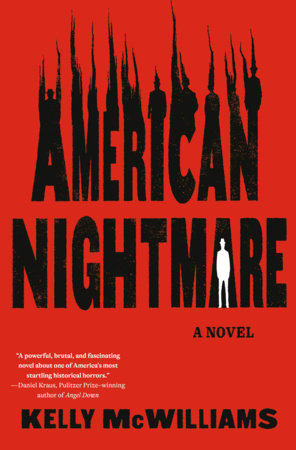
American Nightmare
In 1906 Atlanta, young Clark Wendell White and his father stand guard over their home during the race riot, and Clark encounters a presence he calls the Nightmare.
About
Spoiler notice: This overview discusses the novel’s premise and central conflicts without revealing its ending.
American Nightmare begins in Atlanta in 1906, where young Clark Wendell White and his father stand guard over their family home during the Atlanta Race Riot. Clark perceives a terrifying presence in the violence around him, a figure the novel calls the Nightmare. Years later, that childhood fear remains bound up with the danger he sees in racial violence. Kelly McWilliams uses this supernatural image alongside a specific historical setting, giving the story two kinds of menace to follow: the human systems that make violence possible and the uncanny force Clark believes has been pursuing him. The novel’s title points toward both. Its nightmare is something Clark experiences as a presence, while the book’s historical frame keeps attention on the real people and institutions that can create terror without anything supernatural at all.
As an adult, Clark travels to the NAACP headquarters in New York after seeing an advertisement for light-skinned Black men willing to take on dangerous undercover work. He becomes an investigator of lynchings, entering white communities under an assumed identity so he can report on violence from within. The disguise gives him access, but the work also asks him to live inside a role that can place him in immediate danger and separate him from others. McWilliams builds the thriller around this double life: Clark is trying to expose brutality while performing the identity that allows him to move through spaces closed to him otherwise. The investigation links private risk with public record, asking how testimony can make hidden violence visible and what it costs the person who gathers it.
The novel is inspired by civil-rights activist Walter White, who passed as white while investigating lynchings, but Clark Wendell White is the novel’s fictional protagonist. That distinction matters: the book draws on a documented life as its point of inspiration while giving its own character a childhood encounter with the 1906 Atlanta violence, an inner Nightmare and a particular set of relationships. The historical reference supplies context for Clark’s dangerous assignment, not a claim that every episode in the novel happened to Walter White. McWilliams places invented experience beside the broad historical reality of racial violence and anti-lynching work, allowing the story to explore how a person might enter hostile settings to expose what is happening there. Its suspense comes partly from the gap between the mission’s public purpose and the concealment Clark must maintain to carry it out.
Clark’s cover becomes more precarious when Sam Cahill, an eager recruit in a resurgent Ku Klux Klan chapter in New York, appears able to see through his disguise. The threat therefore grows in two directions: Clark is working against organized racist violence, and one particular man may recognize who he is. Sam is not only an obstacle in an investigation; his encounters with Clark turn on fear, provocation and questions of belonging, making each confrontation dangerous in more than one way. That conflict gives the novel a personal line of tension alongside its wider historical subject. Clark has to judge when to challenge danger and when restraint may keep the investigation alive. The book’s account of passing likewise treats it as a strategy with consequences, rather than a simple change of appearance: the role may permit action, yet it demands ongoing concealment and places his sense of self under pressure.
The investigation also involves Gloria, whose capability and connections do not protect her from being underestimated. Her presence widens the story’s questions about who gets credit for justice work and whose contribution is treated as secondary, even within an organization devoted to civil rights. James Weldon Johnson hopes Clark’s reporting might build enough public pressure to move President Wilson and Congress toward federal anti-lynching legislation. That connection brings the novel’s suspense into contact with a political question: documenting violence may help build pressure, but exposure and change are not the same thing. By giving the work a public audience as well as a personal cost, McWilliams considers how testimony circulates, who is believed, and how much recognition belongs to the people doing the work. Gloria’s place in that discussion makes the struggle broader than one investigator’s courage.
American Nightmare sits between historical thriller and supernatural story. Clark encounters the Nightmare as something that feels real to him. It can also be understood as a response to trauma or a metaphor for systemic racism, leaving the supernatural question open. The book does not need to settle those readings for its central contrast to hold: a ghostly presence may haunt Clark, but the racism and violence around him are not imaginary. This tension lets the uncanny element sharpen rather than replace the historical subject. The novel is interested in how fear travels through memory, how violence can be sustained by people who profit from it, and how the stories of those who challenge it are remembered. Its final effect is to keep the supernatural question open while making the human nightmare impossible to dismiss.
Book details
- Author
- Kelly McWilliams
- First published
- 2026
- Series
- No series listed
- Subgenre
- Historical fiction, Conspiracy thriller
- Primary genre
- Historical Fiction, Mystery & Thriller
- Tags
- No tags for this book.
Review
Editor profile
Baby Bat
Goodreads and social links will be added soon.
- Goodreads — link coming soon
- Social media — link coming soon