
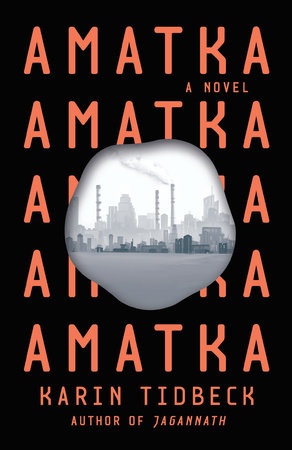
Amatka
Vanja, an information assistant from Essre, travels to the isolated colony of Amatka to gather intelligence about local needs.
About
Spoiler notice: Spoilers for Vanja’s assignment to Amatka, the colony’s naming practices, her relationships with Nina and Evgen, and the early investigation into the settlement’s history. The novel’s final developments are not disclosed.
Amatka begins with an ordinary government assignment in a place where ordinary assumptions do not hold. Vanja, an information assistant from the city of Essre, travels to the remote colony of Amatka to gather intelligence about local needs and the market for hygiene products. The settlement is cold, isolated and short of resources, and its residents are watched for signs of disobedience. Vanja expects a brief work visit, but the colony’s routines and silences make the task increasingly difficult to treat as simple research. Karin Tidbeck builds the novel around a speculative rule that reaches into daily life: objects must be named and reminded of what they are, or they can lose their shape. The premise turns language from a way of describing the world into one of the conditions that keeps the world intact.
That rule changes the meaning of the smallest habits. A label or spoken name is not just useful identification; it helps hold an object together. The colony therefore repeats and inscribes names as part of domestic routine, while lapses carry a material risk. Tidbeck places this fragile reality beside familiar systems of work, housing and administration. People receive roles, share collective living arrangements and depend on carefully maintained supplies. The strangeness is not separated from practical life: an everyday item, a workplace or a record can become part of the same question about what a community must continually affirm in order to endure. Vanja has arrived to ask what Amatka needs, but the assignment brings her into contact with a place where even the terms of a useful answer are unstable.
The trip also moves Vanja away from the more prosperous city she knows and toward a colony sustained by harsh conditions and underground mushroom farms. The landscape and economy make the settlements feel small and exposed, while the restrictions on speech and conduct give daily routines a political weight. Citizens are encouraged to report lapses and suspicious behaviour, and the governing administration presents control as a form of protection. The rationale is connected to the danger of a world in which things may cease to exist as expected. The novel lets that rationale remain part of the colony’s lived reality: security and coercion are intertwined, and the people following rules may also have reasons to question who benefits from them. Vanja’s outsider status gradually shifts from a professional inconvenience into a position from which she can notice these tensions.
Vanja’s planned stay changes when she develops a relationship with Nina, her housemate. Affection gives her a personal reason to remain in Amatka after the assignment should have ended, and it makes the choice to observe the colony from a distance harder to sustain. Their connection takes shape within the same environment that regulates private lives and future choices. The novel links the political and the intimate through concrete decisions: where Vanja lives, how long she stays, what she is willing to ask, and how much risk she will accept. Nina is not simply a route into the settlement’s mysteries; their relationship gives Vanja something to care about in a place that she might otherwise leave. That attachment raises the cost of investigation without turning the story into a conventional romance plot.
Another important connection grows through Evgen, the local librarian, whose concern for the collection brings him into conflict with official decisions. Books and records matter in Amatka because the past is not safely preserved by default. Some materials are scarce or short-lived, and decisions about what can remain available shape what residents can know. Evgen’s work gives Vanja access to questions that her government assignment did not prepare her to ask. Their inquiries touch on the colony’s history and the disappearance of a celebrated poet, whose absence continues to influence how people interpret the official account. The library becomes a place where memory, responsibility and risk meet: preserving a text can be an act of care, but also a challenge to the institutions that decide which versions of events are acceptable.
Vanja’s encounters with Nina, Evgen and other residents make her assignment harder to separate from the larger problem facing the colony. She begins to see signs that the administration is concealing information about a growing threat. The investigation moves through small inconsistencies, guarded conversations and records that do not settle the questions they raise. Rather than giving Vanja a complete map of the world, Tidbeck lets the reader learn alongside her, with new details altering the significance of familiar customs. That approach suits a setting where both physical objects and public explanations require ongoing maintenance. The mystery is not only what happened in the past; it is also how a society teaches its citizens to recognise danger, whose accounts it preserves and what people can safely say when the accepted story begins to fail.
Amatka brings speculative fiction, dystopian social organisation and an intimate relationship into one compact setting. Its central conceit gives language a literal force, while its routines show how rules enter work, memory, family life and personal loyalty. Vanja’s progression from temporary visitor to participant in the colony’s questions supplies the narrative movement, but the book keeps its attention on the people who must make choices before they understand the full situation. Tidbeck’s world remains deliberately bounded: the distant settlements, severe climate and managed resources are presented through what Vanja can encounter, not through an encyclopaedic history. As the investigation develops, her reasons for staying and the colony’s reasons for keeping order become harder to disentangle. The result is a story about how communities hold a shared reality together, and what happens when curiosity and attachment press against the rules that sustain it.
Book details
- Author
- Karin Tidbeck
- First published
- 2012
- Series
- No series listed
- Subgenre
- Dystopian, Weird fiction
- Primary genre
- Sci-Fi
- Tags
- No tags for this book.
Review
Editor profile
Baby Bat
Goodreads and social links will be added soon.
- Goodreads — link coming soon
- Social media — link coming soon