
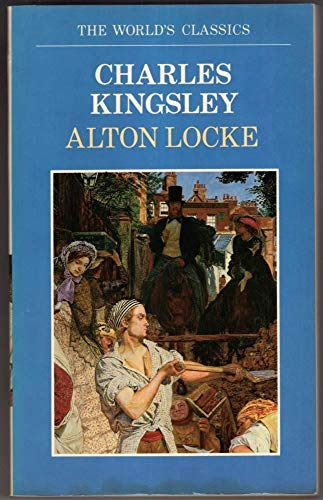
Alton Locke
Alton Locke works as a London tailor while struggling to educate himself and write poetry.
About
Spoiler notice: This overview discusses the publication conditions, Alton’s imprisonment, George’s death and the final letter reporting Alton’s fate.
Alton Locke tells the story of a London tailor who wants to become a poet, looking back on his life while illness and disappointment have changed his understanding of it. The novel takes the form of his autobiography, giving its social arguments the urgency and limitations of a particular person's voice. His earliest world consists of cramped streets, small shops and gardens that offer only hints of the countryside he longs to see. Carts arriving before dawn seem to connect him with another existence beyond the city. That longing grows beside physical weakness and poverty, so the wish for beauty is never entirely separate from a wish to breathe, move and live under less damaging conditions.
Tailoring provides a living while making self-education difficult. Alton must find time and resources for reading around the labour that pays for them, including the candle by which he studies. Sandy Mackaye gives his hunger for knowledge both encouragement and resistance. Lending books is not enough: Sandy challenges his rapid, scattered reading and insists on discipline, setting him to learn Latin through a grammar and Virgil. Their developing friendship offers an education outside the institutions Alton associates with privilege. It also places demands upon him, asking for patience and method rather than simply admiring the possibility that a poor working man might possess unusual gifts. After conflict at home, Sandy's hospitality makes that support still more substantial.
Poetry promises another way of entering the world from which Alton feels excluded. His attachment to Lillian becomes a focus for idealisation, while his knowledge of London working life gives him material of a very different kind. The desire for recognition brings him into contact with people able to offer education, introductions and patronage. Such help can be generous without being free of conditions. When a publisher considers his poems, the proposal includes removing passages of a strong political tendency. The dean encourages him to withdraw from politics altogether. Literary advancement therefore raises a question that skill alone cannot answer: how much of the experience that made him a writer will he have to soften or surrender to become acceptable?
The novel makes that experience concrete through the production of clothes. Its account of an employer's death and his son's new business methods connects commercial ambition with changes in workers' lives. Work once done under the master's roof is to be given out, with the apparent efficiency of cheaper production resting upon the people who must accept it. Alton's political discontent is presented through these pressures, rather than arriving as an enthusiasm detached from daily work. The narration repeatedly addresses readers who buy garments without considering the conditions in which they were made. The same society can admire refinement and respectable appearance while leaving the hands that produce them exposed to hunger, insecurity and disease.
Reform politics also carries Alton beyond his own trade, towards agricultural labourers whose misery gives him further reasons for anger. A confrontation ends in a trial for sedition, riot and arson, with Alton standing beside exhausted labourers as the lawyers construct competing accounts of what happened. His narration of the proceedings conveys bewilderment as well as indignation, showing how distant legal language can feel from the experience it claims to explain. A sentence of three years closes off the future he had filled with possible schemes and achievements. Prison does not merely interrupt a promising career. It changes the scale on which he experiences time, turning days and months into a burden he must confront without the ordinary freedom to act.
Later illness brings Eleanor and other friends into a more intimate relation with him. Their care challenges his bitterness without requiring the reader to forget the conditions that helped create it. The death of his cousin George supplies a particularly sharp connection between distant social worlds: the account links the fatal fever to a new coat associated with an infected lodging house. Clothing becomes the means by which suffering concealed in poor rooms reaches people who imagined themselves separate from it. Eleanor also examines her own motives and pride, rather than remaining simply an untroubled benefactor. Questions about service, responsibility and self-regard belong to the privileged characters as well as to the aspiring tailor they wish to help.
The final chapter brings Alton's political hopes into an explicitly Christian understanding of equality and fellowship. A shared sacrament gathers people of different stations around the chair in which he lies ill, and Eleanor asks him to leave an honest history of his life. He sails with Crossthwaite towards a new country, imagining the possibilities that the emigrants around him hope to find there, while knowing his own strength is failing. The sight of land does not grant him another beginning. Crossthwaite's closing letter from Galveston reports that Alton was found dead in his cabin, his papers and last verses beside him. His story survives through that act of transmission, carrying the testimony he can no longer deliver himself.
Book details
- Author
- Charles Kingsley
- First published
- 1850
- Series
- No series listed
- Subgenre
- Social realism, Coming-of-age, Modern classics
- Primary genre
- Literary Fiction
- Tags
- No tags for this book.
Review
Editor profile
Baby Bat
Goodreads and social links will be added soon.
- Goodreads — link coming soon
- Social media — link coming soon