
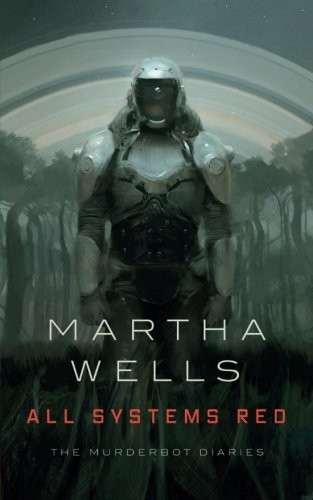
All Systems Red
The security unit assigned to a survey team on an unexplored planet has hacked its own governor module, which means it does not have to obey anyone and could walk away at any time.
About
Spoiler notice: Full-book spoilers, including the ending. This account covers this first book only.
All Systems Red begins with a security construct that has already done something its owners would consider unacceptable: it has disabled the governor module intended to compel obedience. Murderbot, its private name for itself, is not a person discovering emotions for the first time. It already has preferences, anxieties and an inner life that its work leaves little room to acknowledge. Its body combines organic and mechanical components, and its assignment is to protect a planetary survey team. The surrounding commercial system treats such constructs as equipment, issuing instructions and managing contracts rather than asking what they want. Freedom from the governor module therefore has to remain concealed. Murderbot continues doing its job while using its unauthorised access to download entertainment and avoid scrutiny.
Its favourite serial, Sanctuary Moon, offers something very different from an assignment among living humans. Fictional relationships can be watched from a safe distance, without requiring eye contact, explanations or participation. The entertainment is part of a private life Murderbot does not want its clients to inspect. Its armour serves a related purpose. Alongside physical protection, the opaque helmet supplies a barrier between its face and other people’s expectations. Removing it means becoming visible in ways that can feel more threatening than routine security work. Wells uses that discomfort throughout the novella, placing armed competence beside an urgent wish to be left alone. Murderbot’s blunt, defensive narration makes the difference apparent: what it says it wants to avoid is often exactly what its protective actions require it to face.
The PreservationAux survey changes the arrangement when a large creature attacks scientists working in a crater. Murderbot intervenes, suffers serious damage and helps calm a frightened human during the rescue. Dr. Mensah, the team’s leader, notices both the protection and the reassurance. Her concern for the injured construct is awkward for a narrator accustomed to being regarded through its function. The attack also exposes a practical problem: the creature should have appeared in the region’s hazard information. The group discovers missing material in its survey package and contacts DeltFall, the other known expedition, to compare records. At first, poor-quality company software seems a plausible explanation. Faulty data is familiar enough that sabotage does not have to be their first assumption.
Further exploration confirms the omissions, and then DeltFall stops responding. During the journey to investigate, Murderbot learns that the Preservation crew has been trying to respect its reluctance to socialise. Their concern still does not make conversations about its feelings welcome. At DeltFall’s habitat, the danger becomes unmistakable: members of the expedition are dead, and hostile SecUnits are waiting. The encounter leaves Murderbot badly damaged and implanted with a combat override module that threatens to turn it against its own clients. Mensah helps extract it, but escape from the building does not remove the threat inside its systems. When the others refuse to kill it, Murderbot shoots itself to prevent the override taking control. The action protects the team by placing its own continued existence at risk.
Gurathin removes the override, and Murderbot wakes to find that its secrets have become group knowledge. Its disabled governor module, private name and entertainment habits are all exposed. Gurathin also raises the earlier incident in which Murderbot killed clients, treating its independence as a potential danger rather than evidence of trust. Murderbot explains that it hacked the governor to prevent another malfunction. The others must now confront a fact their original contract concealed: it has been choosing to protect them. Their investigation points towards an unacknowledged third expedition, later identified as GrayCris. With their emergency beacon destroyed and their habitat unsafe, they leave in transport hoppers. Mensah needs Murderbot’s judgement, while Murderbot’s attachment to the crew makes abandoning them a prospect it cannot comfortably accept.
GrayCris wants valuable remnants of an earlier civilisation and is prepared to eliminate competing surveyors to secure them. Negotiation becomes a way to buy time for an emergency beacon launch. Murderbot presents itself as a rogue construct willing to trade information for passage away, playing upon assumptions about what an independent SecUnit must want. The plan moves through deception, a change of uniform and the danger of armed constructs whose actions are themselves overridden. It does not depend on a clean distinction between evil machines and good humans. When the beacon launches, its inadequate safety provisions put Mensah at immediate risk. Murderbot breaks from its position and carries her off a cliff to escape the blast, sustaining damage severe enough to take it offline. The crew refuses to discard it.
Survival leaves another decision. Mensah buys Murderbot’s contract, and Pin-Lee obtains protection against the routine erasure of its memory. A future in Preservation is offered with freedom to pursue something beyond security work. The kindness is real, but an offered future is still not necessarily a chosen one. Murderbot leaves secretly on a cargo transport, taking the opportunity to decide where it will go for itself. Its departure does not erase its affection for Mensah or the importance of what the team has done. It refuses to let gratitude settle every question about identity and ownership. The novella’s closing movement therefore follows through on the opening hack: autonomy means having an inner life, protecting boundaries and making decisions that well-intentioned people may not have expected or preferred.
Book details
- Author
- Martha Wells
- First published
- 2017
- Series
- The Murderbot Diaries, book 1
- Subgenre
- Robot and AI, Space opera
- Primary genre
- Sci-Fi
- Tags
- No tags for this book.
- Reading order
- Also on this shelf: Network Effect (book 5)
Review
Editor profile
Baby Bat
Goodreads and social links will be added soon.
- Goodreads — link coming soon
- Social media — link coming soon