
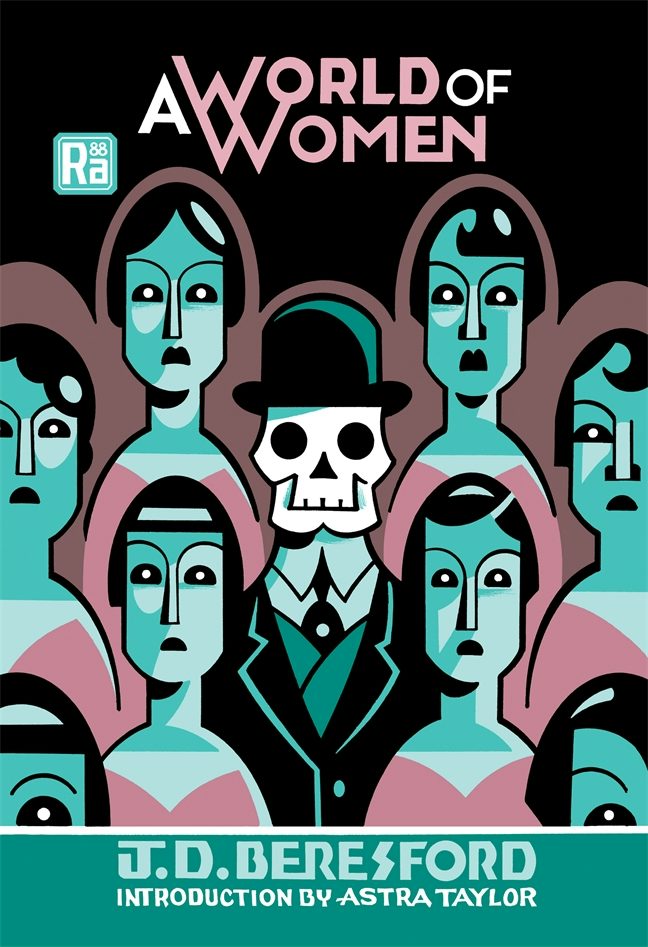
A World of Women
A devastating plague breaks the routines of George Gosling’s respectable London household and leaves women doing much of the work of survival.
About
Spoiler notice: This overview discusses the plague, the women’s departure from London, the flood and the final American expedition and epilogue.
George Gosling has spent his life making himself respectable. His rise through the office hierarchy has brought a reliable salary, a suburban house and a place in the activities of his church and neighbourhood. At home, familiar arguments about shopping and money are repeated almost as rituals. That predictable world opens J. D. Beresford’s 1913 novel Goslings, also published as A World of Women. The approaching plague is initially another item of news, something distant that established authorities ought to manage. The title’s larger catastrophe therefore grows out of an ordinary household’s assumptions. Money will buy necessities, men will provide, and the institutions surrounding the family will continue to function. The novel follows what happens when those assumptions cease to describe the conditions in which anyone has to live.
Jasper Thrale understands the threat earlier than people who can afford to regard it as someone else’s problem. His experience as a traveller and reporter gives urgency to his attempts to secure a public warning, but newspapers and political institutions have priorities of their own. Evidence competes with party interest, commercial judgment and the reluctance to disturb an accepted account of events. Debate over closing communications with Europe exposes another difficulty: isolation also threatens the supply of food on which the country depends. When cases appear in Scotland, the danger stops being hypothetical. People who have the means try to leave, while the security promised by their previous way of life contracts rapidly. Beresford gives the crisis a history of warnings and decisions, rather than having civilisation vanish between one chapter and the next.
For Gosling, survival first means protecting the household through an improvised version of the work he already knows. Possessing keys to his employer’s provision warehouse, he arranges a raid with a coal merchant who can supply horses and carts. He insists on thinking of their appropriation as borrowing. The return journey becomes a grim deception: disguised as workers carrying plague victims, they discourage hungry people from examining the provisions beneath their tarpaulins. Food is stored behind locked doors and boarded windows, giving the family a temporary shelter from the city’s destruction. Yet this success cannot make the house independent of water, public services or the outside world indefinitely. Gosling’s ingenuity briefly supports the old arrangement without restoring the network that once made it ordinary.
The epidemic leaves women responsible for much of the struggle to keep England alive, but the book’s disease is not simply a mechanism that kills every man and spares every woman. Female cases occur, and the ending supplies an important account of different outcomes elsewhere. Within the English narrative, the practical result is a mass departure from towns where stored supplies are failing. Gosling’s wife and daughters must learn that cash and social position cannot produce food where no functioning market remains. Blanche becomes increasingly attentive to what the new conditions demand, while her mother continues to look for the assurances of the old world. Encounters with farming households make survival depend on exchanges of goods and labour. The movement into the countryside changes what counts as useful knowledge and whose judgment deserves attention.
Aunt May gives that change a conversational, human form. Talking with Blanche after a working day, she explains the pleasure of earning food close to the land without pretending that agricultural life offers unlimited comfort. Grain must be grown, harvested and shared; learning is urgent because eating depends on it. Elsewhere, the community around Marlow tries to organise work and access to necessities under conditions for which its inherited rules were never designed. The narrative links a claim to the produce of the earth with labour, while milling and harvest become collective problems. Emergency does not permanently abolish differences of class, religion or temperament. Once immediate pressures ease, people have more room to quarrel again. Keeping a community alive and agreeing about how its members should live remain distinct achievements.
Thrale’s partnership with Eileen brings machinery, affection and public expectations together. At Marlow, their work helps secure a store of flour, and he begins considering whether salvaged dynamos might provide electric light. Before that improvement can be attempted, prolonged rain creates another emergency. Water backs up along the river, threatening the town while unattended weirs downstream need to be opened. Thrale prepares a steam launch, and Eileen insists on accompanying him and operating its engine. The journey requires the practical competence she has acquired, while their relationship is complicated by assumptions about what the women around them will think. The flood makes reconstruction tangible: someone must maintain waterways, handle fuel and understand equipment. Ideas about a new society cannot keep its homes dry without that work.
The arrival of an American liner changes the survivors’ sense of how alone they have been. On board, Thrale and Eileen hear that the disease took a different course across the Atlantic, producing prolonged paralysis from which many patients recovered. Care and food production had occupied the survivors there, delaying any expedition. Their failure to communicate had encouraged each side to imagine the other gone. The renewed connection offers assistance without completing the reconstruction ahead. Thrale thinks about coal, steel and restoring communications; Eileen imagines a future without dependence on inherited wealth and restrictive distinctions between people. Her enthusiasm is a proposal, not evidence that every disagreement has been overcome. The final image of a stranded boat floating again captures the ending’s hope: movement is possible, but there is still a world of work to do.
Book details
- Author
- J. D. Beresford
- First published
- 1913
- Series
- No series listed
- Subgenre
- Classic science fiction
- Primary genre
- Sci-Fi
- Tags
- No tags for this book.
Review
Editor profile
Baby Bat
Goodreads and social links will be added soon.
- Goodreads — link coming soon
- Social media — link coming soon