
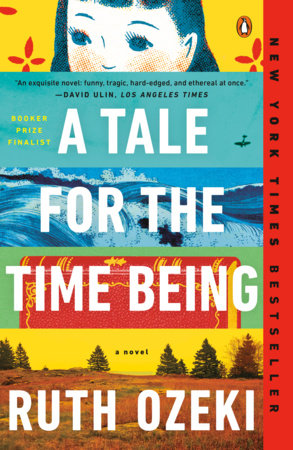
A Tale for the Time Being
In Tokyo, sixteen-year-old Nao begins a diary about her life and her great-grandmother Jiko, a Buddhist nun.
About
Spoiler notice: Spoilers cover the opening premise and Nao's diary reaching Ruth; later developments and the ending are not disclosed.
A Tale for the Time Being begins with an act of reading across a distance. In Tokyo, sixteen-year-old Nao writes in a diary about the life she is living and the past she wants to record. Across the Pacific, a novelist named Ruth finds a Hello Kitty lunchbox among objects washed ashore on a remote British Columbia island. The book moves between Nao’s first-person account and Ruth’s effort to understand the diary and its unknown writer. This arrangement makes the reader share Ruth’s basic uncertainty: the pages offer an intimate voice, but the person behind them remains outside reach. The novel’s opening question is therefore both practical and personal—what does it mean to encounter another life through words, especially when the writer cannot answer back?
Nao’s circumstances give her diary its urgency. She has returned to Japan after her father’s work in Silicon Valley ended, and she finds herself isolated and bullied at school. She writes with a mixture of bravado, anger, comic bluntness and fear, describing the present while turning to her great-grandmother Jiko, a Buddhist nun who has lived for more than a century. Nao intends to tell Jiko’s story, and the project gives her a reason to look beyond the immediate cruelties of school and family life. Yet her narration does not make her into a simple emblem of innocence: she can be harsh, contradictory and keenly observant. That complexity matters. The diary is not a polished account composed for approval; its changing moods make it feel like a young person trying to hold on to a self while the surrounding world keeps defining her.
Jiko provides a counterpoint to Nao’s sense of being trapped in the present. Her long life, Buddhist practice and daily routines offer Nao a different vocabulary for difficulty, attention and change. Ozeki brings Zen ideas into the story through ordinary acts and conversations rather than treating them as detached lessons. Questions about how to live in a particular moment sit beside Nao’s very immediate needs: to be heard, to understand her family, and to imagine a future. The contrast between teenage urgency and Jiko’s accumulated experience gives the novel one of its central rhythms. It also complicates the idea that wisdom simply passes from elder to child. Nao’s writing has its own authority, while Jiko’s influence does not erase the pressures Nao faces.
Ruth’s sections form a second, very different strand. She lives with her husband Oliver on an island in British Columbia and is trying to make sense of the lunchbox and its contents. The items may have crossed the ocean after the 2011 tsunami in Japan, but their precise history is uncertain, and Ruth cannot treat the possibility as proof. Her search involves reading, research and attempts to locate information about the people whose traces she has found. Oliver, who studies the island’s natural environment, shares the household but approaches the world through his own work and habits. Ruth’s part of the story includes doubts and interruptions as she reads Nao, so the book shows not just one story but a mind responding to another story in real time. Author Ruth Ozeki has described this character as semi-fictional and the novel as a parable about fiction-making; that context helps explain the deliberate closeness between reader, writer and character without turning the novel into autobiography.
The two strands meet through more than the mystery of where the lunchbox came from. Nao writes toward an imagined reader, while Ruth becomes that reader and feels responsible for what she learns. The book asks how much can pass between people who never meet, and how interpretation changes the thing being interpreted. Ruth’s reading is active: she searches, worries, forms hypotheses and sometimes confronts the limits of what she can know. Nao’s account, in turn, makes space for history, popular culture, school life, family strain and reflections on time. Their voices are distinct, but each is shaped by a relationship to someone absent or difficult to reach. This gives the novel a metafictional structure that remains grounded in human stakes: reading can create connection, but it cannot guarantee rescue or remove uncertainty.
Ozeki also lets large ideas enter through concrete details. The Pacific carries material traces of human life as well as stories; family memories connect present choices with histories that began before the narrators were born; and Nao’s account brings in scientific and philosophical questions without pausing the novel for a lecture. Quantum mechanics, Zen, environmental change, technology and myth are among the subjects the book touches. They are not all treated as equivalent kinds of explanation. Instead, they widen the questions raised by the diary: how many versions of a life can coexist, how the past inhabits the present, and what responsibility one person has toward another. The humor is part of this balance. Nao’s sharp voice and Ruth’s self-questioning keep the book from becoming solemn even as it approaches loneliness, bullying and the possibility of suicide with care.
The result is an inventive work of literary fiction built around suspense, reflection and a conversation that seems improbable but becomes emotionally consequential. Readers who want a tightly bounded mystery may find that its investigation repeatedly opens into questions about memory, identity and the act of storytelling. Readers drawn to layered narrators will find a novel attentive to the difference between telling a life and living it. Its movement between Japan and coastal British Columbia is also a movement between scales: one girl’s notebook, a family’s history, an ocean carrying objects, and the fleeting present in which a reader holds a book. A Tale for the Time Being does not make uncertainty disappear. It asks what forms of attention remain possible when certainty is out of reach, and what a story can offer to someone who chooses to listen.
Book details
- Author
- Ruth Ozeki
- First published
- 2013
- Series
- No series listed
- Subgenre
- Literary fiction, Epistolary novel
- Primary genre
- Literary Fiction
- Tags
- No tags for this book.
Review
Editor profile
Baby Bat
Goodreads and social links will be added soon.
- Goodreads — link coming soon
- Social media — link coming soon