
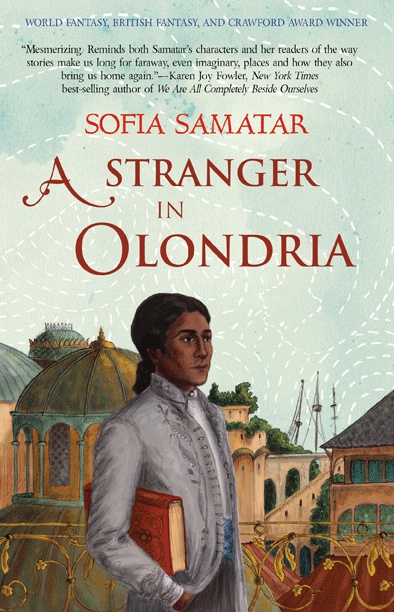
A Stranger in Olondria
Jevick, a pepper merchant’s son, has grown up hearing stories about Olondria, a distant country where books are plentiful.
About
Spoiler notice: Spoilers cover Jevick’s childhood, journey to Olondria, encounter with the ghost and the conflict that draws him in. The ghost’s full story and the novel’s ending are not disclosed.
Jevick grows up on the Tea Islands listening to his mother’s stories of Olondria, a faraway country that his home regards as the Ghost Country. Books are scarce where he lives, and the place he imagines through other people’s words becomes a destination long before he sees it. After his pepper merchant father dies, Jevick takes over the annual selling journey to Olondria. The voyage carries him from familiar island life toward the harbor city of Bain, whose streets, markets and books answer some of his childhood curiosity. His arrival feels like the fulfilment of a private dream, but being a visitor means he must learn how to read the country’s customs and divisions as well as its written works. The novel begins as a young man’s passage into a coveted world and a new understanding of what it means to belong there.
Olondria first reaches Jevick through literature: the books he longs to read, the poems he admires and the stories that give its landscapes shape. His excitement about the country is therefore also an excitement about language. The printed word lets him travel beyond the limits of his island, while his journey makes him confront the distance between an imagined place and one inhabited by people with their own histories. Jevick’s education is not simply a matter of acquiring knowledge or status. He must consider whose words he trusts, how unfamiliar names and beliefs affect his judgment, and what it means to encounter someone whose experience differs from his own. Reading offers connection, but it can also encourage him to mistake another person’s life for a story he already knows.
That distinction becomes urgent when Jevick is haunted by the ghost of a young girl he met on the journey. She is illiterate, and her presence disrupts the pleasure he has taken in entering a country of abundant books. What does it mean to know a person through a written account, and who has the power to make that account? The ghost cannot be folded neatly into Jevick’s literary dreams. He must face the gap between the stories he has learned to value and the life that presses on him now. His fear and uncertainty send him to Olondrian priests for help, turning a private haunting into a matter that religious authorities may claim the right to interpret. The supernatural premise thus tests the limits of reading as a way to understand another person.
The priests Jevick approaches belong to a country divided between two powerful cults. As their conflict draws him in, he becomes a pawn in struggles larger than his own concerns. Olondria’s politics are not a distant backdrop: they shape the choices available to a stranger seeking help and influence the meaning assigned to the ghost. The novel lets religious disagreement remain complex, rather than reducing it to a simple contest between the enlightened and the superstitious. Jevick’s education in the country includes discovering how authority works, whose knowledge is recognised and how belief can organise public life. With war looming, he has to reckon with the costs of being entangled in institutions whose purposes extend beyond the explanation he first wanted.
The book also sets oral and written knowledge beside one another. Jevick comes from a place where stories are carried by voices and books are uncommon; in Olondria, reading seems at first to offer an almost limitless store of other lives. Yet writing also supports bureaucracy and military power, while oral expression remains alive among people with less public authority. That conflict gives the ghost’s illiteracy particular weight. Her need to be understood raises questions about who can enter a record and who remains outside it. Jevick’s love of books is not dismissed, but the novel asks him to see that written culture is neither neutral nor sufficient. Attending to another person requires more than collecting words about them.
Jevick’s route through Olondria brings together wonder, fear, political pressure and the work of empathy. The cultured world he has dreamed about can be beautiful and intellectually rich, yet it is also a place of unequal power and unsettled conflict. He must confront his own assumptions as he tries to make sense of the ghost and the institutions claiming authority over her. This gives the journey an inward dimension: entering another country changes not only what Jevick sees but also the habits of thought he brings with him. His effort to help is bound up with questions of representation and freedom, since understanding the girl’s story may be necessary to release them both from the haunting. The novel keeps those personal stakes in conversation with the larger divisions of the empire.
A Stranger in Olondria follows the movement from a boy’s imagined destination to the difficult responsibilities of living among strangers. Its fantasy setting is built through travel, cultural contact, competing beliefs and the abundance of texts that Jevick discovers beyond his home. The ghost story gives these concerns an immediate human form, while his dependence on priests places him within the country’s political and religious tensions. Samatar’s novel returns to the attractions and limits of reading: books can transport, preserve and connect, yet a written version of another life cannot replace listening to that person. Jevick’s encounter asks what knowledge obliges him to do, and whether he can help free someone without turning her into an object of his own imagination. The questions of art and life, home and exile remain intertwined with his effort to understand what he has been given to read.
Book details
- Author
- Sofia Samatar
- First published
- 2013
- Series
- No series listed
- Subgenre
- Classic fantasy, Literary fiction, Ghost story
- Primary genre
- Fantasy, Literary Fiction
- Tags
- No tags for this book.
Review
Editor profile
Baby Bat
Goodreads and social links will be added soon.
- Goodreads — link coming soon
- Social media — link coming soon