
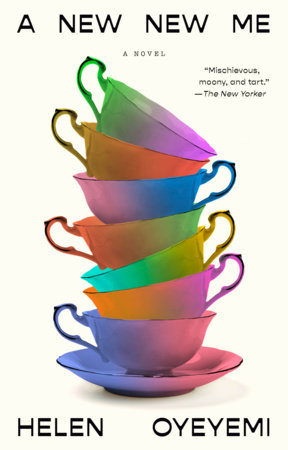
A New New Me
Kinga’s life is divided among seven weekday selves, Kinga-A through Kinga-G, whose different jobs, habits and temperaments require constant negotiation.
About
Spoiler notice: Setup spoilers: Kinga-A through Kinga-G share one life across the week, and Kinga-A finds a man tied up in their apartment. Later developments and the resolution are not summarized.
A New New Me takes the familiar promise of a fresh start and gives it a sharply literal complication: Kinga has a different version of herself for each day of the week. Kinga-A through Kinga-G share one life, but they bring distinct temperaments and habits to it. The arrangement makes getting through an ordinary week a matter of coordination among people who are also, in a bodily sense, one person. The book’s central question is not simply whether Kinga can change. It asks what happens when the parts of a self expected to cooperate have separate priorities, incomplete knowledge and reasons to distrust one another. The title’s repeated promise of becoming new is thus tested against a schedule that keeps returning: after one day ends, another Kinga takes over, and the shared life has to continue. The calendar is more than a scheduling trick: it decides which Kinga can answer a message, attend a meeting or make a commitment on any given day.
The book’s early setting makes Kinga’s divided life concrete in Prague. On the Monday when we meet her, the forty-year-old Polish-born Kinga is collecting her Czech passport after gaining citizenship. Her morning has the odd texture of a routine assembled from personal rituals: she crunches instant coffee granules, repeats Snoop Dogg’s daily affirmations translated into Czech, and tries on outfits. At the passport appointment she meets Milica, a woman who insists on becoming her friend. Kinga then goes to work, carrying a new official status into a day already governed by the Monday version of herself. These details place the uncanny premise amid recognizable errands, small habits and encounters in a specific city.
Kinga-A works as a matchmaker at a large bank, where her department was established in response to a proposed Czech Fidelity Awards scheme for couples together for fifty years or more. At work she compares personalized news alerts with her colleague Eva: Eva’s feed reports on the European rabbit-jumping championships, while Kinga’s carries a story about the Luxury Enamel Posse, a group associated with home invasions and strange objects such as loose teeth and blank checks. The publisher’s description gives Kinga-A’s Monday app deletion and Kinga-E’s Friday bath as contrasting routines; the Los Angeles Times review adds these workplace details. Together they show the novel moving between ordinary employment and an unsettling news environment without separating the two into different worlds. The bank’s unusual department also gives Kinga-A a job built around other people’s long-term relationships, even as she struggles to maintain agreement among her own weekday selves. Eva’s news feed becomes a small counterpoint to Kinga’s: the two colleagues share an office routine but receive sharply different accounts of what is happening beyond it.
A more troubling problem arrives when Kinga-A finds a man tied up in the apartment. His presence gives the Kingas a concrete mystery to face, while the threat reaches into the fragile system they have built for managing their week. The official description keeps the circumstances deliberately open, but makes clear that the discovery forces the group to consider whether one of them may be planning to destroy the others. The question changes the scale of their disagreements. What began as competing habits and resentments now carries the possibility of danger from within, and the Kingas have to contend with uncertainty about one another as well as about the stranger in their home. The publisher offers no explanation of how the man came to be there, so the discovery functions as a question for the characters and the reader rather than a solved incident.
The Kingas keep a collective notebook so one day’s self can leave memories for the others. The entries include practical information about work as well as personal preferences, crushes and appointments. That record does not settle disagreements: Kinga-A’s account of the others is immediately challenged by Kinga-B, who resents her condescension. Kinga-B responds by refusing work and laundry and trying to draw the other selves into a strike on their own days. This is a specific way the shared-life arrangement becomes a dispute over labour and authority, not just a rotation of moods. The group needs the record to coordinate, yet every account is written by someone with a partial view and her own reason to frame events. A notebook can preserve what one version remembers, but it cannot guarantee that the next version accepts her description. Kinga-B’s challenge turns the record into a site of argument as well as a practical handover. The form keeps the selves in contact while showing why contact alone does not produce trust.
The week-long structure therefore has a clear setting and a concrete documentary form. The action takes place in Prague across seven days, with Monday’s Kinga-A and the successive weekday selves steering the same existence. Their notebook entries give the reader access to separate accounts, while contradictions between them leave some events unsettled. The tied-up man brings a second strand of uncertainty into that record: Kinga-A says she does not know him, and the publisher’s description establishes that his presence makes the Kingas question one another’s intentions. The story’s frame is easy to follow—the calendar advances—but the information inside it remains contested. This account stays with the early setup and does not resolve how the man arrived or what the Kingas eventually decide.
Book details
- Author
- Helen Oyeyemi
- First published
- 2025
- Series
- No series listed
- Subgenre
- Literary fiction
- Primary genre
- Literary Fiction
- Tags
- No tags for this book.
Review
Editor profile
Baby Bat
Goodreads and social links will be added soon.
- Goodreads — link coming soon
- Social media — link coming soon