
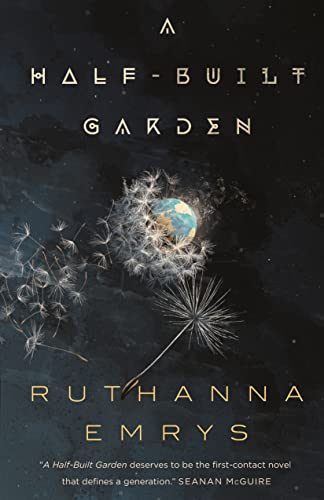
A Half-Built Garden
In 2083, Chesapeake Bay watershed volunteer Judy Wallach-Stevens investigates an unusual water-quality alert and encounters extraterrestrial visitors.
About
Spoiler notice: Spoilers for the opening discovery and the novel’s central first-contact and political conflict; the ending is not summarized.
Ruthanna Emrys sets A Half-Built Garden in 2083, after environmental damage has changed how human society is organised. Judy Wallach-Stevens is part of the Chesapeake Bay Watershed Network, a local community that monitors its ecosystem and makes decisions through shared participation. Its practical work begins with sensors, volunteers and public discussion rather than a distant central authority taking charge. That structure is not an abstract backdrop: it shapes who learns about a crisis, who speaks for the people affected and how quickly responsibility spreads. The future is recognisably connected to present concerns about climate damage and corporate power, yet the novel gives its characters institutions they have built in response, with habits, obligations and imperfections of their own.
The first-contact event grows out of that everyday system. Judy is on call for a water-quality alert when she and her wife, Carol, investigate unusual readings near the Bay. Their infant daughter, Dori, is with them, so the discovery arrives amid childcare, sensor checks and messages to the network. The object they find is an alien vessel, and Judy has to decide whether to treat the disturbance as a local emergency or bring the wider community into it. Emrys places a family at the point where a planetary event becomes real. The scene joins intimate routine with uncertainty: protecting a child matters, but so does giving other people the information they need to respond.
The visitors complicate the idea of a rescue. They believe Earth’s technological civilisation is on a path toward ecological catastrophe and offer humanity a place among them, away from its damaged home world. The watershed communities, however, have spent decades trying to repair the planet and are reluctant to abandon that work. The central question is therefore not simply whether the aliens are friendly. Their proposal may be sincere and still conflict with human priorities, because leaving Earth would mean surrendering a shared home and the unfinished effort to make it livable. The encounter asks how one society can take another’s warning seriously while retaining the right to decide what kind of future it wants.
Judy’s role expands as the discovery attracts attention beyond the Chesapeake network. Other human institutions have different interests and different claims to authority: weakened nation-states, corporate organisations and networks that have grown from local cooperation. The first people to meet the visitors cannot automatically speak for every community on Earth. Negotiation becomes a problem of representation as much as translation. Who is entitled to accept an offer on behalf of humanity? What counts as consent when the consequences reach everyone? The novel’s political movement follows these questions through conversations and competing proposals rather than reducing first contact to a single leader’s decision. Its networked setting makes the process visible and sometimes unwieldy. Consensus is a method for distributing authority, not a guarantee that everyone agrees. The network can circulate evidence and invite expertise, but it still has to decide when discussion is sufficient and how to act under pressure. The arrival of a ship makes those questions harder because delay and unilateral action each carry consequences.
The story also makes room for the material details of the society Judy inhabits. Shared decision-making depends on communication tools, records and the willingness of people with different knowledge to contribute. Ecological monitoring is connected to everyday life, as is the labour of raising children and sustaining relationships. These elements complicate familiar science-fiction images of the future: advanced technologies coexist with domestic care, and planetary-scale choices emerge from ordinary responsibilities. The contrast is central to the novel’s imaginative design. A society may have better tools and a more cooperative structure without becoming effortless or complete; it still needs to handle disagreement, uncertainty and unequal power while attempting to repair damage that is already underway.
Emrys also places the aliens’ assumptions beside the human debate rather than treating technological achievement as proof of moral authority. The visitors have their own history and a model for how intelligent species should survive, but that model leads them to regard planetary departure as necessary. Judy and her community approach the same evidence from the standpoint of people committed to restoring a specific place. This creates tension between care offered from outside and self-determination exercised by those who live with the consequences. The novel’s first-contact story thus turns on competing definitions of survival: whether safety means joining a wider civilisation, or whether a damaged planet can remain a meaningful home worth defending.
Family and community give the large argument its scale. Judy’s relationships with Carol and Dori make the future concrete, while the broader networks show that care can extend beyond a household into civic responsibility. The title suggests an effort still underway: a garden is being made, but it is not finished, and its value lies partly in the work of continuing to build it. A Half-Built Garden connects ecological repair, diplomacy and social organisation through the choice facing its characters. Its opening discovery brings the planetary stakes into one family’s night shift; the ensuing negotiations widen that moment into a question about who gets to shape Earth’s next chapter.
Book details
- Author
- Ruthanna Emrys
- First published
- 2022
- Series
- No series listed
- Subgenre
- Climate fiction, First contact
- Primary genre
- Sci-Fi
- Tags
- No tags for this book.
Review
Editor profile
Baby Bat
Goodreads and social links will be added soon.
- Goodreads — link coming soon
- Social media — link coming soon