
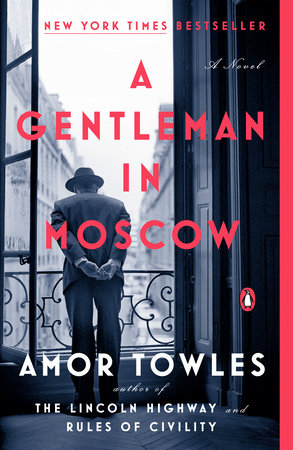
A Gentleman in Moscow
In 1922, Count Alexander Rostov is sentenced to house arrest in Moscow’s Metropol Hotel, across from the Kremlin.
About
Spoiler notice: Spoilers cover Rostov’s 1922 sentence, his confinement and the novel’s broad relationship premise. Later turns and the ending are withheld.
In 1922, Count Alexander Rostov is brought before a Bolshevik tribunal and judged an unrepentant aristocrat. His sentence is house arrest in the Metropol, the grand Moscow hotel across from the Kremlin, where he must live in a small attic room. A man accustomed to leisure and accustomed to being received as a gentleman now has to make a life in a building he cannot leave. The premise sets a sharp boundary around the novel: Rostov’s address is fixed, yet the hotel is never still. Guests arrive, staff move between floors, and the city’s political changes press at its doors. Towles makes the count’s reduced circumstances the starting point for a long study of adaptation. The story asks what remains possible when freedom of movement is taken away, and whether purpose can be found in the small duties and encounters that still lie within reach.
The Metropol gives the story its own geography. Its rooms, restaurants and public spaces bring together people whose lives would otherwise have little reason to intersect. The hotel is at once Rostov’s enforced home and a business that continues to receive visitors; that difference shapes how he experiences it. He must learn to inhabit spaces that once belonged to other parts of his life, while the employees who keep the hotel running become familiar presences. A grand hotel can suggest shelter from the outside world, but the book keeps that shelter porous. News, authority and shifting public life reach the people inside, even when Rostov cannot walk into the streets himself. The setting therefore does more than confine its central character. It supplies routines, obstacles and changing company, allowing the novel to build movement from entrances, conversations, meals and work rather than from a journey across a map.
The sentence also gives the book an unusually long view. Rostov remains in the Metropol for more than thirty years, while major changes unfold beyond its doors. The official description frames those decades as some of the most tumultuous in Russian history, but the narrative’s scale stays close to a life being lived day by day. It does not treat confinement as a simple contest between one clever man and the state; his circumstances are severe, and the larger forces shaping them are not under his control. Instead, the passage of time changes the meaning of familiar rooms and routines. A repeated path through the hotel can lead to a different conversation, obligation or measure of responsibility as Rostov grows older. The contrast between a stable address and a changing world lets the novel examine historical upheaval through its effects on ordinary human relationships, private choices and the ways people learn to endure.
Rostov’s life inside the hotel gradually becomes a network of relationships. The cast includes Nina, Marina, Anna and Sofia, alongside Andrey and Emile, the two colleagues whom the author’s readers’ guide groups with Rostov as the Triumvirate. The publisher also points to the hotel’s seamstresses, chefs, bartenders and doormen as people who become more than background figures over the years. Their work gives the Metropol its daily rhythm, while their proximity to the count creates chances for knowledge, assistance and mutual regard. These connections are not a substitute for the life Rostov lost, and they do not erase the coercion behind his sentence. They do, however, complicate the idea that a person’s world is defined only by where he can go. The novel follows how closeness forms in repeated encounters, and how a changing circle of people can make a restricted life emotionally larger.
Purpose is one of the book’s central questions. Rostov begins as a man whom the tribunal accuses of having no purpose, and his old habits offer little preparation for a life governed by a sentence. The story follows what happens when the measures that once gave his days shape are removed. Work, friendship and care take on different weight when they become choices he can still make inside a limited world. The hotel’s many routines also make attention matter: being present for another person, keeping an agreement or taking responsibility for a task can alter the texture of a day. Towles’s premise invites a distinction between status and usefulness, as Rostov’s social position contracts while his relations with other people grow more consequential. The question is not simply how to remain dignified under pressure, but how dignity changes when it must be practised through one’s obligations to others.
The book’s tone makes room for humor and for serious reflection at the same time. Rostov’s education and wit remain part of how he responds to the world, but they sit beside the practical limits of his sentence and the uncertainty of the decades ahead. Towles’s official description emphasizes emotional discovery, a purpose that deepens as circumstances change. His author site presents the novel as a story of one individual moving through a turbulent era rather than as a chronicle of events alone. That focus keeps the scale personal even as time passes. The Metropol supplies a richly worked setting, but the people in it matter because they bring differing needs, duties and points of view into Rostov’s narrow orbit. The result is a historical novel built around a contained life: the central character cannot choose his boundaries, yet the book traces how he meets the people and decisions within them.
Book details
- Author
- Amor Towles
- First published
- 2016
- Series
- No series listed
- Subgenre
- Literary historical fiction, Historical fiction
- Primary genre
- Historical Fiction, Literary Fiction
- Tags
- No tags for this book.
Review
Editor profile
Baby Bat
Goodreads and social links will be added soon.
- Goodreads — link coming soon
- Social media — link coming soon