
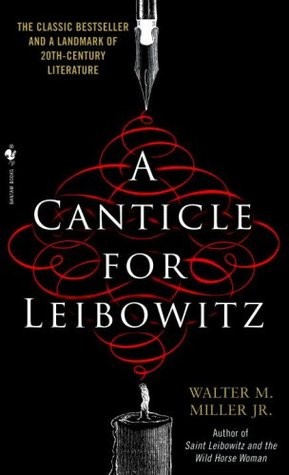
A Canticle for Leibowitz
After a nuclear war, the survivors turn on the people who built the weapons, and most of the knowledge is destroyed.
About
Spoiler notice: Full-book spoilers below, including the ending. This account covers the novel only.
A Canticle for Leibowitz follows an abbey that survives long enough to watch civilisation rebuild the conditions of its own destruction. The nuclear catastrophe remembered as the Flame Deluge has been followed by the Simplification, a revolt against the educated people blamed for making it possible. Books and learning become dangerous, and preserving them requires concealment rather than public celebration. Isaac Edward Leibowitz’s religious order protects fragments of the lost world through copying, memorisation and the smuggling of texts. By the time the novel’s first movement begins, much of what the monks guard can no longer be understood. Their work is an act of faith in future readers: keeping something safe now so that someone, centuries later, might possess the knowledge needed to use it.
Brother Francis encounters that problem during his desert vigil. A wandering pilgrim directs his attention towards a stone, and the discovery beneath it leads to an old fallout shelter. Francis interprets its signs through the fears and vocabulary of his own age, treating fallout as if it might name a creature rather than the consequence of a bomb. Inside are papers connected with Leibowitz, including an electrical blueprint. What was once practical information can now appear as a sacred relic. Francis is excited by the find, but Abbot Arkos sees reasons for caution. The order is pursuing Leibowitz’s canonisation, and a story about an extraordinary visitor could turn valuable evidence into an uncontrolled claim of a miracle.
Francis does not knowingly invent a vision, yet other people enlarge his account until it includes things he never witnessed. His reluctance to make absolute statements about the pilgrim’s identity keeps him under suspicion and delays his vows. Eventually, he becomes a monk and spends years creating an illuminated copy of the blueprint, giving artistic attention to technical marks he cannot explain. On his journey to New Rome, robbers take that beautiful copy while leaving the original, misunderstanding which one matters most. Francis still reaches the Pope and attends the canonisation. He receives money to recover his stolen work, but is killed when he returns to the robbers’ territory. The episode makes preservation intensely personal: years of patient labour belong to a vulnerable man whose life can end much faster than the institutions around him.
Six centuries later, the abbey’s documents can be read with new scientific understanding. Thon Taddeo, an ambitious secular scholar, visits under Abbot Dom Paulo’s supervision, bringing both genuine intellectual excitement and the tensions of his political connections. Brother Kornhoer has constructed a dynamo and an electric lamp, giving a working form to principles being investigated elsewhere. Taddeo is impressed, but also frustrated that the monks have reached knowledge he imagined himself recovering. The visit occurs while Hannegan pursues military expansion, and members of Taddeo’s party study the abbey as a possible fortress. Paulo must welcome scholarship without ignoring the uses a ruler may make of it. Taddeo’s dependence on political patronage prevents a simple separation between innocent discovery and the power that funds it.
Objects and stories bind these distant periods together even though no ordinary human life could span them. Fingo’s carving of Leibowitz remains in the abbey, carrying an ambiguous smile that successive monks interpret differently. The wandering figure also reappears, claiming an extraordinary age, but the novel does not settle his identity into a straightforward explanation. A Poet, with a glass eye and a habit of disrupting solemn occasions, gives another kind of knowledge a place among theology and scientific documents. His presence complicates the assumption that rebuilding means recovering useful facts alone. The abbey preserves a culture made from art, ritual, memory and uncertain testimony as well as diagrams. Those things endure imperfectly, acquiring different meanings as the people interpreting them change.
By the third movement, humanity has regained advanced technology and spaceflight, but it has also returned to nuclear confrontation. Abbot Zerchi prepares a group led by Brother Joshua to carry the order’s work beyond Earth. Meanwhile, victims of radiation poisoning bring an immediate argument about mercy into the abbey’s orbit. Doctor Cors supports euthanasia for people whose suffering cannot be relieved, while Zerchi believes that deliberately ending their lives violates a responsibility that remains binding even in catastrophe. Their disagreement becomes painfully concrete through a mother and her injured child. The novel gives the doctor’s wish to end suffering and the abbot’s concern for the soul opposing claims on the same situation. Technological achievement offers neither man an easy resolution to what they believe they owe the people before them.
Another nuclear blast brings the argument home to Zerchi’s own body. Trapped in the ruined abbey, he experiences the suffering he has urged others to endure. Mrs Grales, a woman whose mutation includes a second head called Rachel, appears with that formerly inactive head now awake. Rachel offers him communion, and his dying perception connects her with innocence and the possibility of resurrection. Elsewhere, children, monks and nuns board the departing starship while mushroom clouds rise on the horizon. The knowledge saved after one disaster will be carried away from another, without a guarantee that its next custodians can prevent the same pattern. The last movement returns attention to nonhuman life in the sea, where a hungry shark persists beneath the falling ash. Human history reaches another ending, while the world continues on terms beyond it.
Book details
- Author
- Walter M. Miller Jr.
- First published
- 1959
- Series
- No series listed
- Subgenre
- Post-apocalyptic, Classic science fiction
- Primary genre
- Sci-Fi
- Tags
- No tags for this book.
Review
Editor profile
Baby Bat
Goodreads and social links will be added soon.
- Goodreads — link coming soon
- Social media — link coming soon