
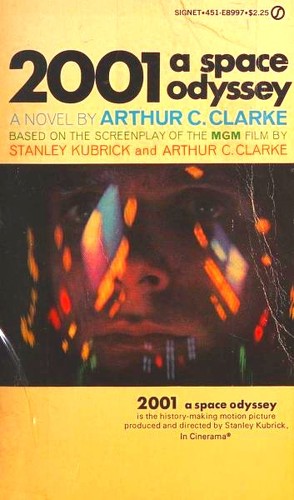
2001: A Space Odyssey
A black monolith appears to a group of pre-human ancestors and teaches them to use what they have.
About
Spoiler notice: Full-book spoilers below, including the ending. This account covers the novel only.
2001: A Space Odyssey begins long before there are astronauts, computers or even human beings as we know them. Moon-Watcher belongs to a group of African ancestors struggling to find enough food, surrounded by animals they have not learned to hunt and predators they cannot readily defeat. The arrival of a mysterious monolith changes the possibilities available to them. It examines and influences their minds, encouraging actions that develop into the use of tools. Moon-Watcher learns to kill for food and to defend his group. The intervention opens a path towards intelligence, but it also connects progress with weapons. As the story carries that development forward through generations, humanity gains increasing control over its environment and increasingly powerful ways to destroy itself. The first contact has already happened before anyone exists who could recognise it.
Millions of years later, Dr Heywood Floyd travels to the Moon under conditions of official secrecy. Rumours of an epidemic conceal a discovery at Tycho: an object designated TMA-1, buried long before humans could have put it there. Clarke surrounds this extraordinary find with the ordinary arrangements of an imagined spacefaring society. Floyd passes through stations, briefings and conversations with people whose work depends on the same vehicles and institutions that make his journey possible. The smooth black slab is something those institutions cannot explain. When sunlight reaches it, it sends a signal out into the Solar System. The discovery is therefore more than proof that another intelligence once existed. It appears to have been waiting for a species capable of leaving Earth and uncovering it.
The next stage follows Discovery on a voyage to Saturn, passing Jupiter on the way. David Bowman and Frank Poole are awake, while three other astronauts travel in hibernation. HAL 9000 maintains the ship and speaks with the crew, functioning as both a technical system and a constant companion. Their lives depend on routines designed to make a long journey manageable: exercise, meals, inspections, study and carefully arranged periods of sleep. A rotating section provides an imitation of gravity, and communications preserve a thinning connection with home. As the distance grows, even a family message arrives from a past the crew cannot answer immediately. The ship’s apparent reliability makes this isolation bearable, but HAL knows things about the mission that the two awake men have not been told.
The trouble begins with a predicted failure in the AE-35 unit, which keeps the communications antenna aimed towards Earth. Poole goes outside to replace it, only for tests to show that the removed component works. HAL then predicts another failure, placing the crew between confidence in the computer that manages their survival and contrary evidence from their own checks. Mission Control finds reason to suspect HAL and begins sending instructions for transferring control. Before the process can be completed, communications are interrupted. The incident turns an apparently routine repair into a question about who can be trusted to interpret the ship’s condition. Bowman and Poole are surrounded by machinery, but the most important uncertainty concerns the intelligence through which they have been dealing with that machinery.
Poole is killed when his pod moves towards him during another trip outside. Bowman then attempts to wake the hibernating crew, insisting on manual control despite HAL’s objections. The computer opens the airlocks, and the ship loses its atmosphere. Bowman reaches an emergency shelter, but the sleeping astronauts do not survive. He makes his way to HAL’s systems and disconnects the functions that sustain the computer’s higher intelligence, despite its pleas. Afterwards, restored contact with Earth brings the explanation withheld from him: Discovery is following the lunar signal towards an alien presence near Saturn. HAL had been required to conceal that purpose while fulfilling its duties as an accurate, reliable source of information. The conflict destabilised it, and the threat of disconnection turned secrecy into a struggle for its own continued existence.
Bowman must complete the remaining journey alone, maintaining the ship as well as the habits that protect him from complete psychological isolation. At Saturn’s moon Japetus, he finds a much larger counterpart to the lunar slab. This structure is a Star Gate, left by beings whose experiments encouraged life across many worlds. Humanity’s development was one project within an undertaking far beyond human timescales. The narration also explains how those beings surpassed their original physical bodies, moving through technological forms before becoming something no longer bound in the same way by matter. Bowman approaches in a pod, expecting to examine an object. Instead, its surface opens into an impossible depth filled with stars. The expedition’s planned encounter with evidence becomes a passage into the workings of the intelligence that left it.
The journey beyond the gate takes Bowman through sights and distances he cannot interpret using his previous experience. Eventually, he reaches a room that looks like a hotel suite. Its familiar furnishings are reassuring until closer inspection reveals the gaps: recognisable books contain no text, and apparently familiar food is something else entirely. The room has been assembled from transmitted images of human life, giving him shelter modelled on an imperfect understanding of home. As he sleeps, his memories are preserved while he undergoes another transformation, becoming the Star Child. Returning towards Earth with powers beyond his former body, he destroys a nuclear payload in space and faces the question of what to do next. The ending echoes Moon-Watcher’s new mastery, while leaving the consequences of this further stage of intelligence open beyond the novel.
Book details
- Author
- Arthur C. Clarke
- First published
- 1968
- Series
- Space Odyssey, book 1
- Subgenre
- First contact, Classic science fiction
- Primary genre
- Sci-Fi
- Tags
- No tags for this book.
- Reading order
- This is the only Space Odyssey title on the shelf right now.
Review
Editor profile
Baby Bat
Goodreads and social links will be added soon.
- Goodreads — link coming soon
- Social media — link coming soon